The Sapphire Engagement Ring Guide: Everything You Need to Know

For millennia before the diamond's marketing rise in the 20th century, the sapphire was the gemstone of love, loyalty, and nobility. Medieval clergy wore sapphires to symbolise heaven; rulers carried them as symbols of wisdom; lovers exchanged them as tokens of fidelity. The word "sapphire" derives from the Greek sappheiros — and the Greeks believed the stone belonged to the god Apollo. Today, the sapphire engagement ring is experiencing a profound revival — driven in part by the enduring influence of one ring worn by one person since 1981, and sustained by a genuine desire for colour, rarity, and individuality that the diamond alone cannot provide. At Zizov, we source exceptional sapphires through our position in the Antwerp gem market, including no-heat Burma, Kashmir, and Ceylon stones of investment-grade quality. This is the complete guide.
01. Why Sapphire? The Case for Colour
The argument for a sapphire engagement ring is simultaneously emotional and practical. Emotionally: blue is the colour most universally associated with depth, fidelity, and calm permanence — exactly the qualities an engagement symbolises. A vivid blue sapphire carries immediate visual presence that reads from across a room in a way that even a beautiful diamond cannot fully replicate. It is colour that commands attention, not just sparkle.
Practically: at 9 on the Mohs hardness scale — second only to diamond at 10 — sapphires are among the most durable gemstones available for daily-wear fine jewellery. They do not scratch from common contact (glass, metal, most surfaces) and have excellent toughness for daily wear. A quality sapphire in a good setting will survive daily wear for generations without losing its colour or polish. See our complete coloured gemstone guide for the full spectrum of options beyond sapphire.
02. The Diana Ring — A Legend Explained
In 1981, a 12-carat oval blue sapphire surrounded by 14 round diamonds in a white gold halo setting was selected from a Garrard jewellers catalogue and placed on the finger of Lady Diana Spencer. It was an unconventional royal choice — the ring was commercially available to anyone. No matter. It became the most photographed, most discussed, and most replicated engagement ring in history — and it remains so in 2026.
Princess Catherine (Kate Middleton) has worn the same ring since 2010. Forty-four years since its creation, its design is still the first image that forms in most people's minds when they think of a sapphire engagement ring. The reason is not merely celebrity association — the ring is genuinely beautiful. The oval sapphire, vivid blue, with a radiating diamond halo in white metal, is a composition of colour, brilliance, and proportion that works on every level. It is the template for a reason.
"The sapphire connects you to history, to royalty, and to a tradition of love that existed long before the diamond was marketed as the only stone for an engagement."
03. Colour Grading — The Blue Spectrum
Unlike diamonds, which are graded on a standardised GIA colour scale from D to Z, sapphire colour grading is more qualitative and requires expert eye assessment. The variables are Hue, Tone, and Saturation:
| Colour Category | Description | Value Tier | Best Setting |
|---|---|---|---|
| Royal Blue / Vivid Blue | Deep, saturated, rich — the "classic" sapphire blue | Highest — Burma/Kashmir quality | White gold, platinum |
| Cornflower Blue | Medium blue, slightly violet, velvet quality | Very high — associated with Kashmir | White gold, platinum |
| Ceylon / Sri Lanka Blue | Lighter, brighter, sometimes slightly violet | High — more accessible price point | White gold, rose gold |
| Pale / Pastel Blue | Light, delicate, almost periwinkle | Moderate — beautiful but less rare | Rose gold, yellow gold |
| Dark / Inky Blue | Very deep — verges on black in low light | Lower — too dark loses brightness | Only if tone lightens in natural light |
The ideal: medium to medium-deep blue with good brightness — vivid without being pale, saturated without being dark. The stone should retain brightness across a range of lighting conditions, not only look blue in direct sunlight and disappear under indoor light. This is assessed in person; no certificate description fully captures it. At our Antwerp showroom, we assess sapphires under five different light sources before presenting any stone to a client.

04. Origin — Why Kashmir, Burma & Ceylon Matter
Unlike most gemstones, the geographic origin of a sapphire has a direct and significant impact on its value — often more than the colour grade alone. This is because certain origins consistently produce stones with specific qualities that cannot be replicated from other sources.
Kashmir (India) — The Rarest and Most Valuable
Kashmir sapphires from the Paddar region of Jammu & Kashmir were mined primarily between 1881 and 1930. The deposit is essentially exhausted. Kashmir sapphires have a unique "velvety" quality — a soft, silky texture to the colour caused by fine, evenly distributed inclusions that scatter light internally, creating a non-greasy, almost glowing blue. A certified Kashmir sapphire carries a premium of 100–300% over a fine Burma stone of equivalent colour. They are the gold standard of the sapphire world. Our Antwerp sourcing team occasionally accesses Kashmir stones through the specialist gem market.
Burma (Myanmar) — The Classic Standard
The Mogok Valley in Myanmar has produced exceptional sapphires for over a thousand years. Burma sapphires are known for their vivid, pure blue with fluorescence that makes them appear to glow under ultraviolet light. No-heat Burma sapphires with GRS or Gübelin certification command significant premiums. See our investment guide for the gemstone investment context.
Ceylon / Sri Lanka — Accessible Quality
Ceylon (modern Sri Lanka) produces a wide range of sapphires from pale and pastel blues to vivid cornflower qualities. Ceylon stones are generally more affordable than Kashmir or Burma equivalents of the same colour — making them the most accessible entry point for genuine fine quality. The legendary Blue Belle of Asia (392.52ct) was a Ceylon sapphire. For buyers seeking beauty and quality within a defined budget, Ceylon no-heat stones represent exceptional value. Browse our precious gemstone collection.
Other Origins
Madagascar has emerged as a significant source of quality sapphires since the 1990s, including stones that rival Ceylon in colour quality. Australia, Tanzania, and Thailand produce darker, more commercial-grade sapphires that are widely available at accessible price points. For engagement ring quality, Sri Lanka, Burma, and Madagascar are our primary sourcing regions.
05. Treated vs. Untreated Sapphires
The vast majority — approximately 95% — of commercial sapphires are heat-treated to improve colour and clarity. Heat treatment is a standard, widely accepted, and permanent process in the gem trade. It does not diminish the beauty of the stone and produces no lasting instability. The treatment is disclosed on GIA, GRS, and Gübelin certificates.
The No-Heat Premium
A sapphire with laboratory certification stating "no indications of heat treatment" is fundamentally rarer — it achieved its colour through geological process alone, without human intervention. The market premium for no-heat stones ranges from 30–100% above equivalent heated stones, depending on origin and quality. For an investment-grade sapphire, no-heat certification from GRS (Gem Research Swisslab), Gübelin, or GIA is the equivalent of GIA certification for diamonds — the non-negotiable standard. At Zizov, all investment-grade sapphires we present carry full laboratory reports from one of these three houses. Book a consultation to discuss current available stones.
06. Durability for Daily Wear
One of the most common concerns about choosing a coloured gemstone over a diamond for an engagement ring is durability. The concern is largely unfounded for sapphires specifically:
- Hardness 9/10: Sapphires scratch only from contact with diamonds or other sapphires. All common materials encountered in daily life — glass, metal, ceramic, stone — will not scratch a sapphire.
- Toughness: Sapphires have excellent toughness (resistance to fracture) due to their corundum crystal structure, with no natural cleavage planes. They are in practice more resistant to chipping than diamonds, which can chip on cleavage planes under sharp impact.
- Chemical resistance: Sapphires are resistant to acids and common household chemicals at normal exposure levels.
- Practical recommendation: Remove the ring for heavy manual work, contact sports, and swimming in chlorinated pools — the same advice given for any fine jewellery. Follow our care and cleaning guide adapted for coloured stones (warm water, mild soap, soft brush — never ultrasonic if the stone has inclusions). Review our insurance guide for coloured gemstone-specific policy language.
07. Settings That Elevate Sapphires
The Diamond Halo — The Classic
Surrounding the sapphire with a ring of brilliant-cut diamonds is the most historically resonant and visually effective setting for an engagement sapphire. The white diamond brilliance frames and amplifies the sapphire's blue, creating maximum colour contrast. The halo also makes the sapphire appear larger and provides a protective barrier of metal and stones around the centre stone's girdle. The Diana ring is a halo for exactly this reason.
Three-Stone: Sapphire with Diamond Flanks
A centre sapphire flanked by two diamond side stones — in matching oval, cushion, or pear shapes — creates a symmetrical, balanced composition that highlights the sapphire without surrounding it completely. Browse our trilogy collection and our side-stone collection for reference settings that can be adapted for sapphire centres.
Solitaire — The Boldest Statement
A sapphire of exceptional colour and quality needs nothing around it. A claw solitaire in yellow gold allows the stone's colour to be the sole focus — the purest, most confident presentation. This works best with stones of at least 2ct and exceptional colour saturation, where the sapphire can carry the visual weight of the ring alone.
Toi et Moi — Sapphire and Diamond Together
A sapphire paired with a diamond of similar carat weight in a Toi et Moi setting is one of the most striking and personal combinations available. The colour contrast between blue sapphire and white diamond in a single setting is visually arresting. See our Toi et Moi guide and our bespoke service for combined sapphire-diamond designs.
08. Sapphire + Diamond Combinations — The Art of Contrast
The partnership between blue sapphire and white diamond is one of the great classic combinations in fine jewellery — each stone's qualities amplifying the other's. The sapphire's colour is deepened by the surrounding diamond brilliance; the diamond's sparkle is given context and warmth by the adjacent colour. For the complete philosophy of combining coloured gemstones with diamonds, see our coloured gemstone guide.

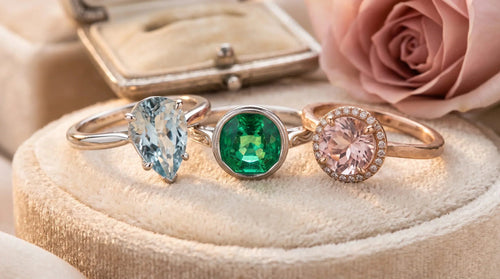
09. Beyond Blue — Pink, Yellow & Other Sapphires
Sapphire is a variety of corundum that occurs in every colour except red (red corundum is ruby). The non-blue sapphires are equally beautiful and offer distinctive character:
| Colour | Character | Celebrity / Note |
|---|---|---|
| Pink Sapphire | From pale rose to vivid hot pink. Feminine, romantic, modern. | Victoria Beckham's pink sapphire collection |
| Padparadscha | Salmon-pink to orange-pink. The rarest and most sought-after sapphire colour. | Princess Eugenie's engagement ring. Extremely rare. |
| Yellow Sapphire | Canary to deep golden yellow. Warm, joyful, and visually impactful in yellow gold. | Growing popularity as a diamond alternative |
| White Sapphire | Colourless. A diamond alternative — less brilliant but very durable. | Budget alternative — greyish compared to diamond |
| Teal / Green-Blue | Blue-green, peacock-like. Distinctive and unconventional. | Strong trend in 2024–2026 among independent jewellers |
For a complete exploration of coloured gemstones beyond sapphire — including rubies, emeralds, and other precious stones — see our coloured gemstone guide and browse our precious gemstone collection and semi-precious collection.
10. The Sapphire Buying Checklist
Before You Purchase Any Sapphire Engagement Ring
✦ Colour assessed in multiple light sources: Natural daylight, fluorescent indoor, and incandescent. A stone that looks vivid only in direct sunlight may appear grey or dark in most real-world conditions.
✦ Origin certificate from GRS, Gübelin, or GIA: For any stone above 1ct, a laboratory origin report is non-negotiable. It confirms origin and treatment status.
✦ Treatment status confirmed: Understand whether the stone is heated or unheated before pricing. No-heat commands a 30–100% premium — ensure you are comparing like with like.
✦ Hardness context: Confirm the stone is sapphire (corundum, 9/10) and not a softer imitation stone. The certificate confirms this.
✦ Setting chosen for sapphire's shape: Oval and cushion sapphires suit halo and three-stone settings. Round sapphires suit both solitaire and halo. Discuss setting options with our bespoke team.
✦ Insurance arranged from delivery: Coloured gemstone policies require specific language about origin, treatment status, and replacement specifications. Our insurance guide covers the exact wording needed.
11. Expert FAQ
Is a sapphire engagement ring a good idea?
A sapphire engagement ring is an excellent choice for daily wear. At 9 on the Mohs hardness scale — second only to diamond — sapphires are the most durable coloured gemstone available. They also carry centuries of symbolic meaning: fidelity, wisdom, and noble loyalty. The practical and symbolic arguments both support the choice. The key is buying a quality stone with proper certification, which our Antwerp sourcing team specialises in.
What colour sapphire is best for an engagement ring?
The most desirable colour is medium to medium-deep blue — vivid and bright without being pale or dark. The descriptions "Cornflower Blue" (associated with Kashmir) and "Royal Blue" (associated with Burma) are the two quality benchmarks. Very dark stones lose brightness in indoor lighting; very pale stones lack visual presence. The ideal is assessed in multiple light sources — which is why we never recommend purchasing a significant sapphire from a certificate description alone. Book a colour assessment viewing.
What is the Princess Diana sapphire ring?
The Princess Diana ring features a 12-carat oval blue sapphire surrounded by 14 round brilliant diamonds in a white gold halo setting, created by Garrard in 1981. It is now worn by Princess Catherine (Kate Middleton). It is the most replicated engagement ring design in history and remains the primary inspiration for sapphire-and-diamond halo commissions. Our bespoke service regularly creates interpretations of this design — with clients' own specifications for sapphire colour, origin, and size.
Are untreated sapphires more valuable?
Yes, significantly. No-heat sapphires — certified by GRS, Gübelin, or GIA as showing no indications of heating — command a 30–100% premium above equivalent heated stones of the same colour quality and origin. For investment-grade purchases, no-heat certification is essential. The certificate does not determine beauty — a heated sapphire of excellent colour is beautiful — but it determines rarity and long-term value. See our investment guide for the full context on coloured gemstone investment.
How much does a sapphire engagement ring cost?
The range is wide. A 1-carat heat-treated blue sapphire of good colour in a simple gold setting starts from approximately €2,000–€4,000. A 2-carat no-heat Burma or Ceylon sapphire of top colour in a diamond halo can reach €25,000–€60,000 or more. Our Antwerp market access removes the retail premium that applies at independent boutiques — book a consultation for current market pricing on your specific specification.
Are sapphires durable enough for daily wear?
Yes — at Mohs hardness 9, sapphires are the second hardest gemstone available and are fully suitable for daily all-day wear over decades. They will not scratch from contact with everyday materials. Their toughness (resistance to fracture) is actually better than that of diamonds in some respects, as they lack natural cleavage planes. Practical caution: remove for heavy manual work, contact sports, and chlorinated swimming pools. Follow our care guide for maintenance.
Find Your Sapphire
Browse our precious gemstone collection and engagement ring collection. Read our coloured gemstone guide for the broader gemstone landscape. For a bespoke sapphire engagement ring commission — including the Diana-inspired halo, a Toi et Moi sapphire-diamond pair, or any custom design — book a private gemstone consultation at our Antwerp showroom. We present stones under five light sources and provide full origin and treatment documentation on every piece we recommend.
Book Sapphire ConsultationZizov Diamonds Antwerp
Excellence in every facet.