The Step-Cut Sophisticate: Emerald vs. Asscher
 Left: The elongated Emerald Cut. Right: The architectural Asscher Cut.
If brilliant-cut diamonds — Rounds, Cushions, Radiants — are disco balls, step cuts are Hall of Mirrors. They do not glitter; they flash. They do not shout; they whisper. The Emerald Cut and Asscher Cut are the choice of the sophisticated buyer who values architectural line and pure geometry over maximised sparkle. For a complete overview of how every shape compares, start with our diamond shape guide. But if a step cut is calling to you, this guide will teach you everything you need to know — including the critical mistakes that even experienced buyers make.
Choosing a step cut is the most demanding purchase in the diamond jewellery world. Why? Because you cannot hide anything. The long, parallel facets act as high-definition windows into the heart of the stone. An inclusion that would be invisible in a round brilliant engagement ring becomes glaringly obvious in an Emerald Cut. Clarity is not a negotiable parameter here — it is the foundation of every purchase decision.
 How L/W ratio transforms the personality of an Emerald cut — from classic square to avant-garde sliver.
Origins: The Art Deco Revolution
While the modern Round Brilliant was perfected in the early 1900s to maximise fire and scintillation, the Emerald cut descends from the "Table Cut" of the 1500s. Originally this shape was used for actual emerald gemstones — the mineral emerald is brittle and prone to cracking under the mechanical stress of cutting. By creating a rectangular shape with bevelled corners, cutters reduced the pressure on the stone during polishing. When the technique was applied to diamonds, the result was a shape of exceptional elegance.
In the 1920s — the Art Deco era — geometric lines, chrome, glass skyscrapers, and mathematical symmetry became the aesthetic language of the age. The clean, straight, industrial lines of the Emerald and Asscher cuts perfectly mirrored this zeitgeist. The cuts fell out of fashion with the rise of brilliant-cut dominance in the 1950s and 1960s, but they never disappeared — and in 2026, they are experiencing their most significant revival since the Jazz Age. Wearing a step cut today is both a nod to Great Gatsby glamour and a distinctly modern design statement.
The Physics of the Hall of Mirrors
To understand step cuts, you first need to understand how differently they handle light compared to brilliant cuts. Brilliant cuts use triangular and kite-shaped facets to chop incoming light into hundreds of small pieces — producing the continuous glittering scintillation that characterises a round brilliant diamond ring or a radiant cut. Step cuts use long, rectangular facets arranged in parallel "steps" down the sides of the stone — like descending terraces when viewed from above.
The "on/off" effect: Because each facet is a flat mirror, it reflects light in one broad, singular flash. As you tilt the stone, entire rectangular bars light up with intense white light, while others simultaneously go dark — providing contrast. This is called "Contrast Brilliance," and it is the defining visual characteristic of all step-cut diamond jewellery.
If a step cut is too deep, light leaks out the bottom and creates a dead, dark centre. If it is too shallow, the stone looks like a pane of glass — transparent rather than luminous. The perfect step cut creates a dizzying, infinite staircase effect that draws the eye through layers of reflected depth.
 The Hall of Mirrors — light descending through rectangular terraces of reflected depth.
The Physics of Extinction
In a brilliant-cut diamond, the primary goal is to eliminate dark zones — to maximise the proportion of the stone that returns light. In a step cut, dark zones are not a defect. They are the point.
When you tilt an Emerald Cut or Asscher Cut, you see bold bars of black turn into bold bars of white in a rhythmic alternation. This contrast — called "Extinction" — is what gives the stone its hypnotic, architectural quality. Without it, the stone would look flat and lifeless.
The Zebra effect: High-quality step cuts display a distinct Zebra pattern of light and dark in continuous alternation. Low-quality step cuts look "washy" — pale, undifferentiated, without the tension of contrast. At Zizov Diamonds Antwerp, we specifically select stones with high-contrast extinction patterns because they command attention even in low-light environments.
The Emerald Cut: Elegant Ratios
The Emerald Cut is the oldest diamond shape still in widespread use for engagement rings and fine jewellery. Its hallmarks are the large, open table, the long parallel step facets, and the bevelled corners that give it a rectangular octagonal outline.
The L/W Ratio: Defining the Personality
Because the Emerald Cut is rectangular, its length-to-width ratio defines its entire character. This is the most important single number for any Emerald Cut engagement ring purchase.
- 1.30–1.40: The Classic ratio. Balanced, substantial, and traditional. This is the "old money" proportion — equally appropriate for an engagement ring, a pendant, or a cocktail ring.
- 1.45–1.55: The Finger Slimmer. The modern preference for engagement rings. This elongated ratio maximises the visual slimming effect on the hand, creates a statuesque presence, and photographs magnificently.
- 1.60+: The avant-garde. Approaching baguette territory — extraordinarily architectural and distinctive. Not for every buyer, but unforgettable on the right hand.
Zizov recommendation: We hunt specifically for ratios between 1.45 and 1.55 for engagement ring purposes. This Goldilocks zone creates a regal, elongated presence without approaching baguette proportions. Visit our Antwerp showroom to see these ratios side by side on the hand — the difference is transformative.
The Asscher Cut: The Royal Windmill
Invented in 1902 by Joseph Asscher in Amsterdam — just north of our Antwerp Diamond District headquarters — the Asscher Cut was the first patented diamond cut in history. It reached legendary status when Joseph Asscher was commissioned to cleave the 3,106-carat Cullinan Diamond for the British Crown Jewels, an act of extraordinary technical courage that we describe below.
The Windmill Pattern
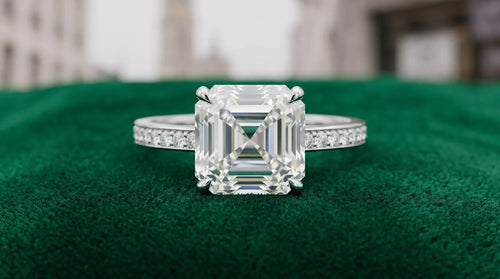
A true Asscher cut (formally a Square Emerald Cut) displays a mesmerising "X" pattern in the centre where the pavilion facets converge. This is called the Windmill — and it draws the eye through the surface of the stone into an apparently infinite depth. Combined with the octagonal outline created by the deeply cut corners, the Asscher has a visual character unlike any other shape in our collection.
 The Windmill — the X pattern at the heart of a high-quality Asscher cut diamond.
Antwerp Insight: Look at the corners. A generic "Square Emerald Cut" often has small, shallow corner cuts. A true Asscher style has wide, deeply clipped corners — making the stone read as almost octagonal when viewed from above. This distinction affects both the visual character and the price. When you book a consultation with us, we can show you both side by side so the difference is immediately clear.
The Cullinan Legend
The history of the Asscher cut is genuinely dramatic. In 1908, Joseph Asscher was tasked with cleaving the Cullinan Diamond — the largest gem-quality diamond ever found, at 3,106 carats. He studied the stone for months, mapping its internal structure and calculating the precise angle. On the day of the cleave, the first blade broke. On the second attempt, the diamond split perfectly along its natural cleavage plane — and legend says Asscher immediately fainted from the accumulated stress. This legacy of high-stakes, unforgiving precision is baked into every Asscher cut diamond in existence. It is an unforgiving shape that demands absolute perfection from the cutter — which is why Antwerp cutting standards matter so much for step-cut purchases.
The Newspaper Test: A Practical Trick
How do you assess a step cut's light performance without specialist equipment? The Readability Test.
The method: Ensure the stone is loose (not set in a ring). Place it table-face-down on a piece of printed text. Look through the stone from above.
The result: Because step cuts are "windows," you might expect to read the text clearly. But a well-cut Emerald Cut or Asscher Cut refracts light enough that the text becomes scrambled and unreadable. If you can clearly read the letters through the centre of the stone, the diamond has "Windowing" — light is leaking straight through the pavilion rather than reflecting back to your eye. Reject this stone immediately. This is one of the key quality checks we perform on every step-cut stone before it enters our Antwerp inventory.
Confusion Buster: Emerald Cut vs. Radiant Cut
Many buyers confuse the Emerald Cut and the Radiant Cut because they share the same outline — a rectangle with bevelled corners. But they are fundamentally opposite in their visual character and practical requirements. See our Radiant vs. Princess guide for a full breakdown of the Radiant's unique characteristics.
- Emerald Cut (Step Cut): Long, slow, broad flashes. Understated, architectural, "old money" vibe. Hides nothing — requires VS1 clarity or higher.
- Radiant Cut (Mixed Brilliant): Thousands of small, continuous sparkles. Energetic, bold, "glitter bomb" vibe. Hides inclusions exceptionally well — can drop to SI1 clarity in some cases.
The verdict: if you want to see the crystal, choose an Emerald Cut. If you want to see the sparkle, choose a Radiant. Both are beautiful — they simply perform completely different visual functions. Our complete shape guide helps you decide which character matches your personality.
The Clarity Trap: Why You Need VS1
This is the most critical single piece of advice in this entire guide. Do not compromise on clarity with a step cut.
With a round brilliant engagement ring, you can frequently find an SI1 or even SI2 stone that appears eye-clean — the intense scintillation scrambles the light so effectively that inclusions are rendered invisible. With an Emerald Cut or Asscher Cut, the large, open table acts as a magnifying glass. The same inclusion that disappears in a round becomes immediately visible to the naked eye in a step cut.
The Hockey Puck effect: An inclusion located in the centre of a step-cut stone will be reflected by the surrounding pavilion mirrors — making one black speck appear as five or six identical reflections repeated throughout the stone. A single SI1 inclusion can visually dominate an entire Emerald Cut diamond.
The Zizov clarity guide for step cuts:
- VVS1 / VVS2: The ideal choice. Absolutely clean in all lighting. The standard we recommend for engagement rings and significant pendants.
- VS1: Usually safe — but inclusions must be positioned at the edges (where prongs will cover them) rather than in the centre.
- VS2: Risky. Only acceptable if the inclusion is white (crystal) rather than black (feather) and is confirmed hidden under a prong.
- SI1: Almost never eye-clean in a step cut of any meaningful size. Avoid for engagement rings, pendants, or any piece where the stone will be viewed closely.
The Lustre Factor: Colour & Metal
Because step cuts return broad flashes of white light rather than continuous sparkle, they mask body colour reasonably well — better than most buyers expect. The "on/off" pattern draws the eye to the light rather than the warmth. However, the large open facets do expose the physical quality of the crystal itself — you can see the actual material, not just a field of sparkle.
We love Emerald cuts and Asscher cuts in G or H colour. The subtle warmth adds a vintage, velvety quality that complements the antique character of these shapes beautifully. Set in 18k yellow gold, an H colour Emerald Cut has a depth of character that a colourless stone in platinum simply cannot replicate. If you want the "ice" look — pure, crystalline white — stick to D–F colour in platinum, but budget accordingly.
For coloured gemstones in step-cut shapes — particularly our emerald collection, rubies, and sapphires — the step-cut faceting creates a depth of colour saturation unique to this style. The broad facets act as colour-intensifying mirrors in a way that brilliant cuts do not.
Emerald vs. Asscher: Side-by-Side
| Feature | Emerald Cut | Asscher Cut |
|---|---|---|
| Shape | Rectangle (elongated, bevelled corners) | Square (octagonal, deeply bevelled corners) |
| Vibe | Sophisticated, regal, "old money." The choice of Amal Clooney and Beyoncé. | Vintage, architectural, Art Deco. The Elizabeth Taylor choice. |
| Face-Up Size | Looks larger — weight is spread over a long, wide surface area. | Looks smaller but deeper — the weight goes into depth rather than spread. |
| Sparkle Type | Long parallel flashes. Bold horizontal bars of light and dark. | Concentric squares converging on the Windmill X. More compact and hypnotic. |
| Best Setting | Three-stone with baguettes, East-West solitaire, bezel. | Four-prong solitaire, bezel, baguette halo. |
| Metal Pairing | Beautiful in both yellow gold (G–H colour) and platinum (D–F colour). | Historically most associated with platinum — the icy tone complements its geometric precision. |
| Clarity Requirement | VS1 minimum. VVS preferred for 2ct+. | VS1 minimum. VVS preferred — the Windmill pattern amplifies any central inclusion. |
| Rarity | More common — greater supply means better value for size. | Significantly rarer — particularly high-quality examples with perfect windmill symmetry. |
Case Study: 3ct Emerald vs. 3ct Asscher
Two stones from our Antwerp inventory, both 3.00 carats, both VS1 clarity, both G colour, both set in platinum. The difference in visual experience is dramatic.
 Same carat weight, radically different visual footprint on the finger.
- 3.00ct Emerald Cut: Dimensions 9.50mm × 7.00mm. Surface area 66.5mm². Effect: massive finger coverage — looks like a 3.5ct stone. The elongation creates a dramatic slimming effect and the long bars of light read from across the room.
- 3.00ct Asscher Cut: Dimensions 8.00mm × 8.00mm. Surface area 64mm². Effect: compact and architecturally deep. Looks smaller in terms of footprint but possesses the Windmill depth that makes it feel like a portal rather than a stone.
The verdict: If you want maximum visual presence and finger coverage for your investment, the Emerald Cut wins clearly. If you want a rare, hypnotic art object with a unique visual character found in no other diamond shape, the Asscher Cut is in a category of its own. Book a private comparison at our Antwerp showroom — this is the decision that genuinely requires seeing both in person.
Best Settings for Step Cuts
1. The East-West Setting
Setting an elongated Emerald Cut horizontally across the finger — rotated 90 degrees from the conventional orientation — is one of the most distinctive contemporary engagement ring statements available in 2026. It protects the stone beautifully, creates a unique "bar of light" effect across the hand, and reads as architecturally modern rather than conventionally bridal. A pairing for a bespoke commission conversation.
2. The Bezel Set
A thin gold or platinum bezel (a continuous metal rim surrounding the entire stone) is perhaps the most historically appropriate setting for step cuts. It emphasises their geometric outline, protects the bevelled corners from any chipping risk, and creates an Art Deco homage that feels both period-accurate and thoroughly modern. Available across our natural diamond ring collection or as a custom commission.
3. Three-Stone with Tapered Baguettes
The classic Antwerp fine jewellery look. A large Emerald Cut flanked by two tapered baguette side stones — all step-cut, all in the same facet language. The baguettes lead the eye toward the centre stone, framing it rather than competing with it. This is the setting style that made the Emerald Cut synonymous with Amal Clooney and Old Hollywood glamour. Explore our side-stone collection for examples, or discuss a custom version with our bespoke team.
Styling Your Stack: Wedding Bands for Step Cuts
The most common mistake buyers make with step-cut engagement rings is pairing them with a brilliant-cut eternity band or a pavé wedding ring. The sparkle styles clash — the band glitters like a brilliant while the centre stone flashes like a mirror, creating visual chaos rather than harmony.
For stacking guidance, our complete stacking guide covers the principles in detail. For step cuts specifically:
- The Match (Baguette Band): Pair your Emerald Cut or Asscher Cut with an East-West set baguette band. Step facets next to step facets — the result is a seamless, architectural composition with no visual conflict. Available as a matching bespoke set.
- The Contrast (Micro-Pavé Band): If you want some brilliance in your stack, use very fine micro-pavé rather than bold pavé. The tiny diamonds provide textural warmth without competing with the centre stone. Our eternity band collection includes appropriately scaled options.
- The Cigar Band (Plain Gold): A wide, polished plain gold band in 18k yellow gold or platinum is the definitive "old money" choice. The absence of any decoration throws every visual emphasis onto the geometry of the centre stone. Understated, confident, and entirely correct.
Famous Step Cut Diamonds
Step cuts have always been the choice of those who value substance over spectacle. The most significant step-cut diamonds in history share a common thread: they belong to people who understand that true luxury does not need to announce itself.
Elizabeth Taylor — The Krupp Diamond
Perhaps the most famous diamond ring in history. Richard Burton gave Taylor this 33.19-carat Asscher Cut in 1968. A Type IIa stone (chemically pure) with wide, open corners of exceptional proportions. It defined the "architectural diamond" look for an entire generation and remains the most cited reference point for the Asscher style.
Amal Clooney — The Intellectual Choice
When George Clooney proposed, he chose a 7-carat Emerald Cut in platinum with tapered baguette side stones. The classic three-stone step-cut composition — understated, serious, and undeniably brilliant. It remains the single most influential engagement ring of the last decade for the professional buyer demographic.
Beyoncé — The Power Ring
Jay-Z proposed with an 18-carat Flawless Emerald Cut by Lorraine Schwartz. The split-shank setting allows the massive rectangular stone to appear to float on the finger — the Emerald Cut's elongation doing its characteristic work of making an already extraordinary stone appear even larger. A masterclass in how proportion ratios and setting choice interact to produce maximum visual impact.
The Zizov Buying Checklist
Step cuts are unforgiving. Use these specifications to filter out inferior stones before you even look at the price. For any purchase at our Antwerp showroom, we apply every one of these checks as a matter of standard process.
Must-Haves for Emerald Cut
- Ratio: 1.40–1.55 for engagement ring purposes (elegant elongation without approaching baguette)
- Clarity: VS1 minimum — VVS preferred for 2ct and above
- Table: 60–69% (open but not excessively wide)
- Depth: 61–68% (avoid flat stones that window, and deep stones that go dark)
- Colour: G or H for yellow gold; D–F for platinum
- Newspaper test: Text must be unreadable through the stone — windowing is an automatic rejection
Must-Haves for Asscher Cut
- Ratio: 1.00–1.03 strictly (must be visually square)
- Clarity: VS1 minimum — the Windmill amplifies any central inclusion
- Windmill: Must be clearly visible, symmetrical, and centred
- Corner Depth: Wide, deeply clipped corners (true Asscher style vs. generic Square Emerald)
- Table: 60–68%
- Depth: 61–67%
Deal Breakers for Both
- Windowing: Can you see clearly through the stone like glass? Reject immediately
- Excessive extinction: More than 35% of the stone black when face-up at arm's length? Reject
- Dead corners: Do the corner facets light up, or do they remain permanently dark?
- No ASET/video: Never buy a significant step cut without a high-resolution video or in-person inspection — the GIA certificate alone is insufficient for step-cut evaluation. Book an Antwerp viewing.
The Investment Perspective
Are step cuts a good long-term investment? The answer is nuanced — and worth understanding before any significant diamond purchase. Our 2026 natural stone investment guide covers the full landscape, but here is the step-cut specific picture.
Rarity factor: High-quality Asscher cuts — square, perfectly symmetrical, VS1 or better clarity — are significantly rarer than round brilliants. This scarcity supports value retention. Premium Emerald cuts at VVS clarity and D–F colour are equally limited in supply.
Liquidity: Round brilliants are the "cash" of the diamond world — the most liquid shape by a wide margin. Emerald and Asscher cuts are "real estate" — slower to find the right buyer, but deeply appreciated by those who seek them. An investment-grade step cut must be VVS clarity or better, D–F colour, and professionally certified by GIA or HRD. These top-of-the-pyramid specifications are consistently sought by collectors and serious buyers. For insurance purposes, a current GIA or HRD certificate paired with a Zizov appraisal is the correct documentation.
3 Step Cut Myths Debunked
Myth 1: "Step Cuts Don't Sparkle"
False. Emerald cuts and Asscher cuts absolutely produce intense light return — but the character of that light is completely different from a round brilliant or a radiant. It is a bold, rhythmic, "on/off" flash rather than continuous twinkling scintillation. More lighthouse beam, less disco ball. In the right lighting — particularly in candlelight or under directional sources — a step cut produces a dramatic light performance that no brilliant cut can replicate.
Myth 2: "Step Cuts Look Smaller"
Partially correct only for the Asscher Cut, which carries significant weight in depth. For Emerald Cuts, the opposite is true — a 2ct Emerald frequently appears larger than a 2ct Cushion or Radiant because the weight is distributed across a long, flat surface area rather than concentrated in depth. The elongation also creates a visually slimming effect on the finger. For size-per-carat efficiency, the Emerald Cut is one of the best available in our collection.
Myth 3: "You Need a Halo to Make Them Pop"
Please avoid this approach with step cuts. A round-stone halo around a step-cut engagement ring creates a fundamental mismatch of visual languages — the structured geometry of the step cut surrounded by a chaotic ring of brilliant-cut sparkle. If you want to add to a step cut, use linear elements: tapered baguettes, trapezoids, or plain metal prongs that respect rather than interrupt the architecture of the stone. Our side-stone collection and bespoke service specialise in exactly this kind of considered composition.
Frequently Asked Questions
Can I set an Emerald Cut East-West?
Yes — and it is one of the most distinctive contemporary engagement ring choices available right now. Setting the Emerald Cut horizontally across the finger highlights the step facets as a horizontal bar of light and reads as architecturally modern. It also offers excellent stone protection. Our bespoke team creates East-West settings regularly — book a consultation to discuss.
Why is the "Royal Asscher" different from a standard Asscher?
The "Royal Asscher" is a patented modern update to the original 1902 design, created by the Asscher family in 2001. It adds 16 additional facets (74 total versus 58 in the standard cut) and a higher crown, producing increased brilliance compared to the classic version. Standard Asscher cuts today refer to the Square Emerald Cut with 58 facets — the original Art Deco style that carries that distinctive deep Windmill geometry.
Do step cuts sparkle less than brilliant cuts?
They produce a different type of light performance, not a lesser one. Emerald cuts and Asscher cuts produce longer, broader, more deliberate flashes — a confident, architectural light show rather than continuous twinkling. Some buyers find this more dramatic and satisfying than the busier light return of round brilliants or radiants. See our shape guide for a full character comparison.
Which is more expensive — Emerald or Asscher?
Asscher cuts are generally slightly more expensive per carat. They are significantly rarer (fewer are cut globally each year), and their deeper proportions waste more of the rough crystal during cutting. Emerald cuts are more abundant and offer better size-per-pound value — which is one of the reasons they dominate the step-cut engagement ring market. Both remain less expensive per carat than round brilliants of equivalent quality.
Do Emerald cuts show colour easily?
More than brilliant cuts, yes — but less than many buyers fear. The large open facets expose body colour rather than scrambling it. We recommend H colour or higher for any Emerald Cut intended to appear white. In yellow gold, an H colour actually looks intentionally warm and beautiful — embracing the vintage character of the shape. For a colourless "icy" appearance, choose D–F in platinum.
Are step cuts durable?
The bevelled corners make both Emerald and Asscher cuts significantly more durable than shapes with sharp points (Princess, Pear, Marquise). However, the long straight edges of an Emerald cut can chip from a direct lateral impact. A bezel setting or four-claw setting that protects the long edges is recommended for active wearers. For care and cleaning advice specific to step cuts, see our complete guide.
What is a "Krupp" Diamond?
The "Krupp Diamond" is the informal name for the 33.19-carat Asscher Cut Richard Burton gave Elizabeth Taylor in 1968. It refers to the specific wide-cornered, deeply proportioned Asscher style that this stone exemplified. The name is sometimes used today to describe any large, architecturally proportioned Asscher cut with dramatically wide corner bevels.
Should I get a halo with an Emerald Cut?
We generally advise against a standard round-stone halo for step-cut engagement rings — the brilliant-cut halo stones clash visually with the step-cut centre. If you want additional stones, tapered baguettes or straight baguettes as side stones are the correct architectural choice. If you specifically want a halo, ensure it is composed of baguette-cut or step-cut diamonds to maintain visual consistency. Our bespoke team can design both options for you.
Step into the Hall of Mirrors.
Explore our curated selection of VS+ Emerald Cut and Asscher Cut diamonds at our Antwerp showroom. View them loose, under natural north light, and compare them side by side with Radiant cuts and Round brilliants to feel the difference firsthand. Browse our full diamond ring collection or natural diamond jewellery for inspiration before your visit. Need something quickly? Our express-delivery collection ships from Antwerp in 1–3 days.
View Step Cuts in AntwerpZizov Diamonds Antwerp
Architecture in light. Cut in Antwerp.