The Ultimate Diamond Shape Guide: Finding Your Soulmate Stone

If the 4Cs (Carat, Clarity, Colour, Cut) are the science of a diamond, then the Shape is its soul. It is the first thing people notice from across the room. It defines the personality of the ring — and, by extension, the wearer. Choosing a shape is the most personal decision you will make in the entire ring-buying journey. While a gemologist at our Antwerp showroom can tell you which stone has better clarity or cut efficiency, only you can decide if you are an "Oval person" or an "Emerald person." At Zizov Diamonds, we believe there is a shape for every hand and every story. This guide dissects the ten most popular diamond shapes, revealing their optical secrets, their hidden advantages, and exactly what to look for when hunting for the perfect one.
Before We Begin: The Anatomy Glossary
To understand why an Oval has a bow-tie, why an Emerald cut has a Hall of Mirrors, and why your Princess cut corners need V-prongs, you need to speak the language of the diamond cutter. These five terms are essential to everything that follows.
- The Table: The large flat facet on top — the "window" into the stone. Too large (as in some poorly proportioned Emerald cuts) and the stone looks flat. Too small and it looks dark.
- The Crown: The angled upper section above the girdle. A high crown creates more fire (coloured dispersions); a lower crown spreads light for more white brilliance. The difference is visible side-by-side at our showroom.
- The Girdle: The thin perimeter separating top from bottom — the "belt." This is where the prongs hold the stone. We laser-inscribe every GIA report number here for permanent verification.
- The Pavilion: The bottom cone — the engine room. Too shallow and light leaks out the bottom ("fisheye"). Too deep and the centre goes dark ("nailhead"). Correct pavilion depth is the single most important factor for engagement ring diamonds.
- The Culet: The tiny point at the bottom. Modern cuts have a closed (pointed) culet. Antique cuts like the Old Mine Cut had an open (flat) culet — visible as a tiny circle in the centre of heirloom stones.
01. Round Brilliant: The Undefeated Icon

The Round Brilliant is the gold standard of the industry, accounting for over 70% of all diamonds sold globally. It is technically the most "perfect" cut available — its 57 facets are mathematically engineered to reflect the maximum possible light. Invented in 1919 by Marcel Tolkowsky, whose calculations remain the foundation of every GIA Cut Grade, the Round Brilliant is the only diamond shape with a dedicated, comprehensive cut quality assessment on its certificate. For a complete guide to its specifications, see our engagement ring buying guide.
The Zizov Perspective
If sparkle is your single most important priority, stop reading and buy a Round Brilliant. No other shape can physically compete with its light performance. It hides inclusions better, masks body colour better, and has the most universally recognised silhouette. It is also the most liquid investment shape — the easiest to insure, appraise, and eventually trade. Our insurance guide explains why GIA-certified rounds carry the most straightforward valuations.
- Pro: Maximum sparkle (fire and brilliance combined). Superior inclusion concealment due to intense light return. The only shape with a GIA Cut Grade. Highest liquidity as an asset.
- Con: Most expensive per carat — cutting a round diamond discards up to 60% of the rough crystal, versus only 20% for a Princess cut. The premium over equivalent fancy shapes is typically 25–35%.
- Ideal Ratio: 1.00–1.03 (perfectly circular).
The "Sweet Spot" Buying Guide
Because the Round Brilliant is so effective at masking imperfections through light return, you can often compromise on Colour and Clarity to maximise visual Carat weight without visible penalty. An H or I colour round faces up white when set in yellow gold. In platinum, stick to G or better. An eye-clean SI1 or SI2 is frequently achievable — the intense brilliance scatters light so effectively that small inclusions disappear entirely. This is the opposite of the advice for step cuts, where VS1 minimum is non-negotiable. For eternity bands, round brilliants are the most reliable shape for consistent sparkle across the entire band.
02. Oval: The Lengthening Effect

The Oval has dethroned the Princess cut to become the second most popular diamond shape of the 2020s. It combines the full brilliance of the Round Brilliant with a unique elongated anatomy that flatters virtually every hand. Blake Lively and Hailey Bieber have made the Oval engagement ring the definitive shape of this decade.
The Bow-Tie Effect: All ovals have a bow-tie — a dark shadow across the centre caused by light that enters at the elongated ends and does not reflect back to the eye. In a poorly cut oval, this shadow dominates the stone. In a well-selected Zizov oval, it is barely perceptible — a subtle contrast that adds depth rather than killing sparkle. Avoiding a heavy bow-tie is the single most important challenge when sourcing this shape and the primary reason why in-person viewing or a high-resolution video is non-negotiable. See the bow-tie section in our Radiant vs. Princess guide for a full technical explanation.
- Pro: Faces up approximately 15% larger than a round of the same carat weight due to elongated surface area. Universally flattering on the finger. Typically 10–20% less expensive per carat than a comparable round.
- Con: The bow-tie effect requires expert inspection — a certificate alone is insufficient. Body colour is more visible than in a round; stay at H colour or above for platinum settings.
- Ideal Ratio: 1.35–1.50. Rounder (1.35) for a classic look; slimmer (1.50) for modern elongation.
The Price Gap Strategy
Despite its dominant trend status, the Oval remains 10–20% less expensive per carat than the Round Brilliant. The cutting process uses the naturally elongated shape of many rough crystals more efficiently. This means you can achieve a 2.5ct Oval engagement ring for the budget of a 2.0ct Round — a significant visual upgrade for no additional cost. In a halo setting, the oval's elongated profile creates an unbroken ellipse of surrounding diamonds that looks seamless and immense.
03. Emerald Cut: The Hall of Mirrors

The Emerald cut is not about sparkle; it is about presence. It uses step cuts — long, parallel rectangular facets arranged in descending terraces — that create a "Hall of Mirrors" effect. It flashes with broad, confident beams of white light rather than the continuous twinkling of a brilliant cut. This is the shape of Amal Clooney, Beyoncé, and Grace Kelly. It demands extraordinary diamonds and extraordinary confidence from its wearer. For the complete technical breakdown, see our dedicated Emerald vs. Asscher guide.
"The Emerald cut is the most honest shape. It cannot hide a flaw. It requires a diamond of exceptional clarity."
The large, open table acts as a magnifying glass rather than a light scrambler. An inclusion that is invisible in a Round Brilliant becomes immediately visible in an Emerald cut. We recommend VS1 or higher as a minimum — ideally VVS for stones above 2 carats. This clarity requirement is the single most important distinction between the Emerald cut and every brilliant shape. Save the budget you would spend on cut grade (GIA does not grade Emerald cut quality independently) and redirect it into clarity.
The "Tennis Court" Effect
The elongated Emerald cut (ratio 1.45–1.55) creates a dramatic lengthening effect on the finger — the visual equivalent of a tennis court seen from above: long, clean, and authoritative. It projects calm in a world of chaotic sparkle. In a three-stone setting with tapered baguettes, the step-cut language carries throughout the composition for an effect of complete architectural coherence. For stacking, pair with a baguette eternity band — never a round brilliant band, which clashes with the step-cut character.
Buying Tip: The Extinction Check
When viewing an Emerald cut, tilt the stone gently. A well-cut stone flashes "on" and "off" like a strobe as you rock it — alternating broad bars of white light and dark contrast. If the centre remains permanently dark (a "dead zone"), the pavilion is cut too deep. This is the "Newspaper Test" described in our step-cut guide. Always inspect loose before setting.
04. Cushion: The Romantic Pillow

Imagine a square with soft, rounded corners — like a pillow. The Cushion cut is an antique-inspired shape descending from the 19th-century Old Mine Cut. It is softer and less geometric than the Princess or Radiant — more romantic, more historical, more warm. It also happens to be the best shape for fancy colour diamonds — its facet pattern intensifies colour saturation more than any other shape, which is why the majority of fancy yellows and pinks are cut as Cushions. For the complete technical breakdown of Cushion varieties and proportions, see our dedicated Cushion cut guide.
Chunky vs. Crushed Ice
There are two distinct Cushion faceting families that look completely different despite appearing identical on a GIA certificate:
- Antique Cushion (Chunky Brilliant): Fewer, larger facets producing broad, checkerboard-style flashes. The "Old World" feel. Rarer and more expensive because more rough is sacrificed.
- Modern Cushion (Crushed Ice Modified): Extra pavilion facets creating thousands of tiny sparkles — like a shattered windshield. Excellent at hiding inclusions. Can drop to SI1 or SI2 in clarity without visible penalty.
Meghan Markle's elongated Cushion trilogy ring and Kim Kardashian's 15-carat Cushion solitaire represent both ends of the spectrum — royal romanticism and ultra-modern maximalism. Both work. The Antwerp showroom has examples of both styles side by side — the difference is immediately apparent in person. Browse our Cushion cut collection and our halo ring collection for current options.
05. Pear: The Teardrop

A hybrid of the Round Brilliant and the Marquise, the Pear shape is a symbol of tears of joy. It is the most asymmetric of the classic shapes — favoured by women who want something distinctive rather than merely beautiful. Ariana Grande (set on a diagonal), Margot Robbie, and Victoria Beckham have all worn Pears.
Symmetry is everything: A Pear must be perfectly symmetrical from tip to shoulders. The curved sides must arc at identical angles — even 1mm of imbalance is visible when the stone is set. We also inspect every Pear for a "protected tip" — a V-prong is non-negotiable for the pointed end, identical to the requirement for Princess cut corners. An unprotected Pear tip is a chipping risk.
Buying Tip: The Bow-Tie Check
Pears suffer from the bow-tie effect more severely than Ovals due to the rapid narrowing toward the tip. A poorly cut Pear has a prominent dark shadow that kills sparkle in the most visually central part of the stone. A well-cut Pear's bow-tie is a subtle contrast enhancement, not a dark zone. In a Toi et Moi setting, the Pear pairs beautifully with a complementary Oval — the two organic shapes creating a flowing, asymmetric composition. In a three-stone setting, Pear side stones flanking a centre stone create a powerful sweeping effect. Always request a high-resolution video or book a viewing before any Pear purchase.
How to Wear It
Point-Out (tip toward the fingernail) elongates the hand aggressively — the most universally flattering orientation. Point-In (tip toward the palm) can create a shorter visual line. In bespoke design, rules exist to be intentionally broken — a Point-In Pear in an East-West bezel setting creates a completely contemporary look.
06. Radiant: Fire & Ice

The Radiant cut was invented to solve a specific problem: "I love the rectangular silhouette of the Emerald cut, but I want the sparkle of a Round Brilliant." It achieves both — the bevelled-corner rectangular outline of the Emerald combined with a complex brilliant facet pattern on the pavilion that produces an explosion of light. It is the most durable shape because its cut corners eliminate the sharp, fragile 90-degree tips found on Princess cuts. For the complete technical comparison of Radiant vs. Princess, see our dedicated guide.
The Active Lifestyle Diamond
If you are a doctor, architect, chef, or anyone who uses their hands constantly, the Radiant cut is our top recommendation. Its bevelled corners mean it will not snag fabric, chip on a granite countertop, or catch on a latex glove. You can set it in standard four-claw prongs without the vulnerability concerns that make Princess cuts high-maintenance. The Cushion and Radiant are the two most practical shapes for daily-wear engagement rings.
The Colour Maximiser
Unlike the Round Brilliant, which actively masks body colour, the Radiant cut intensifies it. This is why approximately 90% of Fancy Yellow diamonds are Radiant cut — the shape traps and amplifies the yellow hue. For white diamond Radiants, stay at H colour or above; a J colour Radiant will show visible warmth that a J colour Round would mask. For the colour science explained in detail, see our coloured diamond guide.
07. The Specifics: Marquise, Princess & Asscher
The Marquise — The Boat Shape
Commissioned by King Louis XV of France to match the smile of his mistress, the Marquise has the largest surface area per carat of any diamond shape. A 1ct Marquise looks visually massive next to a 1ct Round. Its two pointed ends make it the most dramatically finger-elongating shape available. Fragility is the trade-off — both tips are as vulnerable as Princess cut corners and must be protected by V-tip prongs in any setting. If cut too wide, it resembles a rugby ball; too narrow, a needle. The sweet spot is a ratio of 1.85–2.10. For significant pieces, book a consultation to see the full ratio range in person.
The Princess — The Square Brilliant
The only true square brilliant cut. It is the geometric inverse of the Round Brilliant — sharp where the Round is curved — but retains nearly equivalent sparkle through a complex chevron facet pattern. The key practical advantages: cutting a Princess cut from a rough diamond discards only 20% of the crystal (versus 60% for a Round), which translates into a 25–35% price advantage. Its 90-degree corners are a structural vulnerability — V-prongs at all four corners are non-negotiable. For the complete guide to buying a Princess cut correctly, see our Princess cut guide. For eternity bands, Princess cuts create the most seamless channel-set channel of all shapes — straight edges sit flush with zero gaps.
The Asscher — The Art Deco Icon
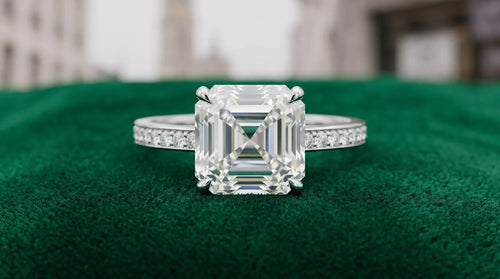
Essentially a square Emerald cut with dramatically wide, deep corner bevels — invented in 1902 by Joseph Asscher in Amsterdam. Famous for its "Windmill" or "X" pattern visible from directly above, and for the deeply hypnotic concentric square Hall of Mirrors effect it creates when viewed through the table. The Asscher was the diamond shape of the Jazz Age and has returned with force as buyers rediscover architectural, thoughtful jewellery over pure sparkle maximalism. Like the Emerald cut, it demands VS1 clarity or better and is particularly striking in platinum. Read our Emerald vs. Asscher guide for a complete comparison of these two extraordinary step-cut shapes.
08. Heart: The Statement

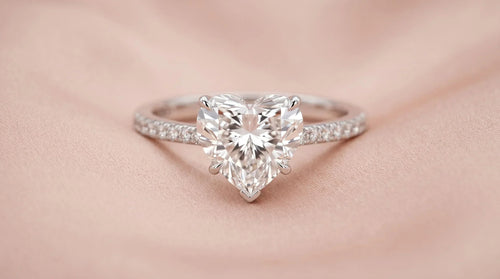
The Heart shape is polarising — you either love it or you do not. It requires a master cutter to ensure the "cleft" (the dip at the top between the two lobes) is sharp and well-defined rather than rounded and ambiguous. In a poorly cut Heart, the shape reads as a rounded blob from any distance beyond arm's length. In a masterfully cut Heart, it is unmistakable and genuinely dramatic. For a bespoke heart commission, the cutting specification conversation is as important as the diamond selection.
The Anatomy of a Perfect Heart
- The Cleft: Must be distinct, sharp, and centred. A soft or asymmetric cleft makes the shape unreadable.
- The Wings: The two rounded lobes must curve at identical angles — symmetry is as critical as in a Pear.
- The Ratio: 0.95–1.05 (nearly square in profile). Above 1.15, it looks stretched; below 0.85, it looks miserable.
- The Setting: The Heart shape is so visually loud that it hates competition. A simple solitaire on a thin gold or platinum band is the correct setting. No halo. No side stones. Let the shape do all the work.
09. The Ratio Masterclass
For every non-round shape, the Length-to-Width (L/W) ratio is the single number that most defines how the diamond reads on the hand. A difference of 0.05 appears negligible on a certificate — but the difference between a 1.40 and a 1.50 Oval is immediately visible on the finger. Getting the ratio right for your specific hand and setting is one of the primary purposes of a private viewing consultation at our Antwerp showroom.
How to Calculate It
Divide the Length (mm) by the Width (mm). Example: a 10mm × 7mm Oval has a ratio of 1.42. This number appears on every GIA certificate under "Measurements."
| Shape | Traditional Ratio | Modern Trend (2026) | Our Guide |
|---|---|---|---|
| Oval | 1.30–1.35 (classic) | 1.45–1.50 (elongated) | Sweet spot: 1.40–1.48 |
| Emerald Cut | 1.30–1.40 (classic) | 1.45–1.55 (tennis court) | Best for engagement rings: 1.45–1.55 |
| Cushion | 1.00–1.05 (square) | 1.15–1.20 (elongated) | Sweet spot: 1.10–1.15. Full guide |
| Pear | 1.50 (balanced) | 1.60–1.70 (slim teardrop) | Avoid below 1.45 (stubby) or above 1.75 (fragile) |
| Radiant | 1.00–1.05 (square) | 1.15–1.25 (elongated) | Full guide: bow-tie above 1.30 |
| Asscher | 1.00–1.03 (square) | 1.00–1.03 (stays square) | Full guide: windmill needs square |
10. Expert FAQ
Which shape sparkles the most?
The Round Brilliant. No contest. Its 57-facet geometry is mathematically optimised for maximum light return — no other shape can physically replicate its efficiency. The Radiant and Oval are runners-up for continuous scintillation. The Emerald cut and Asscher are about broad, dramatic flashes rather than continuous twinkling. See our step-cut guide for the light physics explained.
Which shape looks the biggest?
The Marquise, followed by the Oval and Pear. Elongated shapes distribute their weight across a larger surface area, appearing 15–20% larger than a Round Brilliant of the same carat weight. The Emerald cut at a 1.50+ ratio also faces up very large. The Asscher cut faces up smallest — its weight goes into depth. For a complete face-up size comparison, see our step-cut guide's case study section.
Which shape is the most expensive?
The Round Brilliant commands a 25–35% premium over equivalent fancy shapes because cutting a round diamond discards nearly 60% of the rough crystal. Fancy shapes are more efficient — a Princess cut discards only 20%, a Oval or Cushion approximately 40%. This efficiency is reflected directly in price. Buying through Antwerp additionally saves 21% VAT for non-EU buyers.
What is the best shape for investment?
We always advise buying for love rather than ROI. That said, Round Brilliants and Emerald cuts at D–F colour and VVS clarity have historically held the most stable value. They are the "blue chip stocks" of the diamond world — less susceptible to shifting fashion trends than shapes like the Marquise or Princess, whose popularity fluctuates by decade. Our 2026 investment guide covers this in detail, alongside insurance and documentation requirements.
Do specific shapes suit specific hands?
Yes. Elongated shapes (Oval, Pear, Marquise, elongated Radiant) are universally flattering — they extend the visual line of the finger and create a slimming effect on any hand width. Square shapes (Princess, Cushion, Asscher) suit women with longer fingers who want to add visual width and geometric weight. The definitive way to settle the question is to try stones on your own hand at our Antwerp showroom — book a shape testing consultation.
Find Your Shape
Seeing is believing. Compare all ten shapes side by side at our Antwerp atelier — loose stones under natural north light, on your hand, at your pace. Browse our engagement ring collection, full ring collection, and new arrivals before your visit. Need something immediately? Our express-delivery collection ships from Antwerp in 1–3 days.

Zizov Diamonds Antwerp
Excellence in every facet.