Fire & Brilliance: The Ultimate Radiant vs. Princess Cut Guide
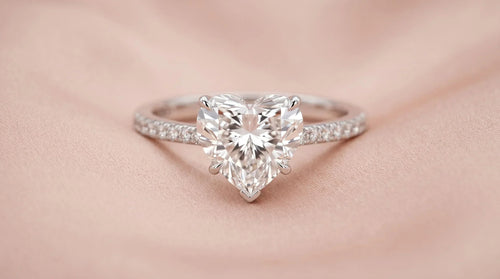
 Left: The chaotic brilliance of the Radiant. Right: The structured fire of the Princess.
It is the eternal debate for clients who want maximum sparkle in a square or rectangular shape. Do you choose the crisp, geometric lines of the Princess Cut? Or the durable, glittering brilliance of the Radiant Cut? At first glance, they might appear similar — both are modified brilliant cuts, both have intense light return, and both offer a contemporary alternative to the round. But structurally, optically, and practically, they are worlds apart. In this guide, we settle the debate — covering every aspect of these two extraordinary diamond shapes and explaining the science of sparkle, the durability differences, the colour behaviour, and how the 2026 elongation trend has reshaped buyer preferences. To understand how these two cuts fit into the broader landscape, start with our complete diamond shape guide. Still deciding on budget? Our gentleman's engagement ring guide covers the 4Cs in plain terms.
 The same weight, the same colour grade — completely different visual personalities.
Origins: The Square Revolution
Before 1977, if you wanted a square diamond, your options were limited. The Emerald Cut and Asscher Cut offered the step-cut square aesthetic but with significantly less brilliance. The Cushion Cut was pillowy rather than truly square. Neither satisfied buyers who wanted geometric precision with maximum light return.
The Radiant Revolution (1977)
Master cutter Henry Grossbard changed the landscape permanently. He wanted to combine the elegant, cut-cornered shape of the Emerald Cut with the fire and brilliance of the Round Brilliant. After years of experimentation, he patented the Radiant Cut — the first time significant brilliance had been achieved in a square shape. Grossbard famously described it as "liberating the square diamond." The Radiant Cut immediately found favour with buyers who wanted the volume of a rectangular stone with the scintillation of a round. You can explore our full collection of Radiant cut engagement rings here.
The Princess Evolution (1980)
Three years later, Betzalel Ambar and Israel Itzkowitz took the concept further. They created the "Quadrillion," later standardised as the Princess Cut. Their goal was not purely sparkle — it was also weight retention. The Princess Cut shape mirrors the natural octahedral crystal structure of rough diamond, allowing cutters to retain up to 80% of the rough (compared to 40–50% for a Round Brilliant). This efficiency makes Princess cut diamonds noticeably less expensive per carat than rounds of equivalent quality. It became the second most popular diamond shape in the world — behind only the Round Brilliant.
The Physics of Sparkle: Chevron vs. Crushed Ice
Both cuts are modified brilliants, but they manipulate light in fundamentally different ways. This is the "Fire" vs. "Ice" distinction that separates the experience of wearing each.
Princess Cut: The Chevron Structure
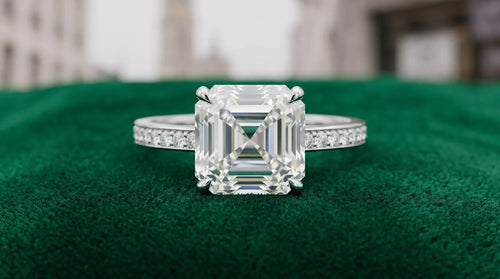
If you examine the pavilion (underside) of a Princess cut under magnification, you will see distinct V-shaped grooves running from the centre toward the corners. These are called Chevrons. When light enters the stone, it strikes these long, flat chevron facets and bounces back in structured, orderly flashes. A well-cut Princess displays a distinct "Black Cross" or "X" pattern in the centre when viewed face-up. This structure produces intense Fire — spectral, rainbow-coloured light dispersions that are vivid and bold. The number of chevron bands (2, 3, or 4) affects the visual character: more chevrons produce a more fragmented, "crushed" look; fewer produce bolder, larger flashes. We prefer 3-chevron stones for the ideal balance.
Radiant Cut: The Shattered Glass Effect
The Radiant Cut has no chevrons. Instead, its pavilion is covered in a complex web of small, irregular facets. Light entering the stone is scattered across dozens of tiny mirrors before exiting — creating the characteristic "Crushed Ice" or "Shattered Glass" effect. There is no pattern, no X, and no ordered structure. Just pure, chaotic, high-frequency Scintillation — the white sparkles that shimmer continuously with movement. A Radiant in motion is simply hypnotic.
 A well-cut Princess shows a distinct "X" in the centre — the Radiant is uniform, continuous glitter.
The Princess Cut: Sharp Precision
The defining characteristic of the Princess Cut is its sharp, 90-degree corners — the only brilliant square shape with pointed, uncut corners. This creates a powerfully geometric, contemporary silhouette that reads as modern and architectural.
The advantage: Unmatched geometric precision. Clean, crisp lines. It also costs less per carat than a round of equivalent quality due to weight retention from the rough. In a halo setting, those straight edges allow the surrounding diamonds to sit flush against the centre stone, creating a seamless wall of sparkle with no gaps.
The limitation: Those sharp corners are structurally fragile. The 90-degree tip is the weakest geometric point of any diamond — a concentrated stress point that can chip from a sharp impact. Princess cut engagement rings must always be set with V-prongs at the corners to protect them. If the corners chip before setting, the stone's grade — and its value — is permanently compromised. Read our complete Princess Cut guide for full setting and care advice.
The Radiant Cut: The Durability King
The Radiant Cut has cut corners — bevelled edges that create an octagonal shape, though your eye perceives it as a rectangle. This small structural difference has significant practical consequences.
 The Radiant's bevelled corners (right) make it significantly more durable than the Princess (left).
The advantage: Durability — and it is substantial. Because there are no sharp points to snag, chip, or concentrate impact stress, the Radiant Cut is our top recommendation for active wearers: doctors, nurses, athletes, mothers with young children, anyone who works with their hands. It can be set with standard claw prongs without the vulnerability concerns of a Princess. It is equally beautiful in a solitaire setting, a halo, or a three-stone setting. It also looks exceptional in a bezel — the metal framing its octagonal shape beautifully.
The consideration: A Radiant cut can occasionally appear visually "bottom heavy" or dark if the depth percentage is too high. This is why proportion checking is essential — see our buying checklist below.
Side-by-Side: The 4 Factors
| Factor | Princess Cut | Radiant Cut |
|---|---|---|
| Sparkle Style | Structured, bold, ordered flashes. The "X" pattern. High contrast. | Chaotic, continuous, high-frequency scintillation. No pattern — pure glitter. |
| Face-Up Size | Standard for weight. | Slightly larger face-up (especially elongated), more finger coverage. |
| Durability | Medium — fragile 90° corners require V-prongs. Vulnerable to chipping. | High — bevelled corners eliminate the sharp-tip vulnerability entirely. |
| Colour Behaviour | Hides body colour reasonably well face-up. Corners can concentrate warmth. | Intensifies body colour. Do not go below H colour for a white appearance. |
| Best Setting | Halo (seamless fit), three-stone with trillions. | Solitaire, bezel, three-stone with trapezoids. |
| Fancy Colour | Works, but Radiant is superior for saturating colour. | The definitive choice for fancy coloured diamonds. |
Antwerp Insight: Radiant cuts intensify colour like no other shape. If you are considering a fancy yellow diamond, a green stone, or any coloured precious gem, a Radiant cut will saturate the colour more deeply than any other shape — which is why approximately 90% of fancy colour diamond sales in Antwerp are Radiant. For white diamonds, stay at H colour or above to avoid visible warmth.
The Ratio Guide
Ratio (length ÷ width) is one of the most important decisions for both cuts — it determines both the visual shape and the price per carat significantly.
Radiant Cut Ratios
Square Radiant (1.00–1.05): The purest square expression. Maximum width coverage. Sits compactly and elegantly on the finger. Popular for buyers who want the Radiant's sparkle without the rectangular footprint.
Elongated Radiant (1.15–1.25): This is the defining shape of 2026. An elongated Radiant cut engagement ring — which deserves proper jewellery insurance from day one — provides substantial finger coverage, creates a visually slimming elongation effect on the hand, and faces up significantly larger than a Round of the same carat weight. Demand has been extraordinary — expect a slight premium of 5–10% over equivalent square Radiants. Beyond 1.30, the bow-tie risk increases — see the next section.
Princess Cut Ratios
Unlike Radiants, Princess cuts should almost always be square. 1.00–1.05 ratio is the safe zone — this ensures the chevron facet pattern is symmetrical and the "X" light return is balanced. Ratios above 1.05 ("Rectangular Princess") typically result from weight-saving decisions during cutting; the light return becomes uneven and the characteristic X pattern is lost. If you want a rectangle, buy a Radiant Cut instead.
 The 1.20–1.25 ratio elongated Radiant is currently the most requested shape in our Antwerp showroom.
The Bow-Tie Problem (Elongated Radiants)
If you are considering an elongated Radiant cut, you must understand the bow-tie effect before purchasing.
A bow-tie is a dark shadow across the centre of an elongated stone that resembles a man's formal bow tie. It occurs in elongated shapes (Oval, Pear, elongated Radiant) when light entering the centre leaks out through the bottom rather than reflecting back to the eye — creating a zone of darkness at the widest point of the stone.
Not all bow-ties are equal. A subtle, light-grey shadow creates contrast that can actually enhance the visual depth of the stone. A heavy, black bow-tie kills the sparkle in the most visually prominent part of the diamond and is completely unacceptable.
The Zizov rule: We accept a shadow (light grey, barely perceptible). We reject blackouts (dark, clearly visible from arm's length). There is no measurement on a GIA certificate that captures this — it is a visual inspection requirement. For any elongated engagement ring purchase, demand a high-resolution video or an in-person view at our Antwerp showroom before committing.
Best Settings for Square Cuts
The Solitaire — Winner: Radiant
A Radiant cut in a thin pavé-band solitaire is one of the most elegant engagement ring combinations available. The bevelled corners allow for delicate standard claw prongs (eagle claw or petite four-claw) that expose maximum stone without visual bulk. For the ultimate expression of this aesthetic, explore our Invisible Diamond Collection. If you have an inherited stone to reset, our heirloom guide explains the process. A Princess cut solitaire, by contrast, requires the more substantial V-prongs at each corner — which can make the mounting appear heavier and more industrial.
The Halo — Winner: Princess
Because the Princess Cut has straight edges and sharp right-angle corners, a square halo fits it with perfect geometric precision — no gaps, no awkward angles, just a seamless frame of smaller diamonds that intensifies the centre stone's apparent size and brilliance. A Radiant in a square halo leaves visible gaps at the cut corners; an octagonal custom halo is possible but costly.
The Three-Stone — Draw
Both shapes are exceptional in three-stone settings, but with different side-stone pairings. Princess with trillions: The sharp triangular lines of trillion-cut side stones echo the angular geometry of the Princess centre perfectly — futuristic, architectural, striking. Radiant with trapezoids: The clean step-cut lines of trapezoid side stones contrast beautifully with the chaotic sparkle of the Radiant centre, creating the classic look associated with the finest Antwerp three-stone rings. Both are equally valid — the choice comes down to whether you want geometric harmony or deliberate contrast. Either setting also stacks beautifully alongside a diamond eternity band; see our stacking guide for the design rules.
The Colour Trap
Colour behaviour is one of the most practically important differences between these two cuts — and the one most buyers underestimate.
The Radiant trap: The Radiant cut was engineered to maximise light return — which means it also maximises body colour. A J colour Radiant will appear significantly more yellow than a J colour Round Brilliant. For white diamond engagement rings, we recommend H colour or higher in any Radiant. The upside: for fancy yellow diamonds, a red rubies, and coloured precious stones, a Radiant is almost always the correct choice — it saturates and intensifies the colour more than any other cut.
The Princess advantage: The structured, high-contrast black-and-white chevron pattern of the Princess cut masks body colour more effectively in the face-up view than the Radiant does. You can often achieve a visually white appearance with an I colour Princess, provided the corners are covered by prongs (which concentrates colour at the tips). Set in yellow gold, even an H or I Princess looks warm and intentional — the metal masks rather than highlights the colour.
Celebrity Heavyweights
Nothing moves the market like a high-profile engagement ring. Here is how these two cuts are represented at the highest level.
Team Radiant
- Jennifer Lopez: Ben Affleck's second proposal featured a rare 8.5-carat green fancy colour Radiant. The soft corners and extraordinary colour intensification made the Radiant the only appropriate choice for this stone.
- Megan Fox: Her Toi et Moi ring pairs a Radiant cut with a Pear shape. The geometric lines of the Radiant balance the organic curves of the Pear beautifully.
- Khloe Kardashian: A substantial Radiant cut with a diamond halo — demonstrating that this shape handles bold, maximalist styling as confidently as it handles minimalist solitaires.
Team Princess
- Emily Ratajkowski: Her Toi et Moi features a 2-carat Princess cut alongside a Pear — chosen specifically for the Princess's sharp, architectural geometry and its striking contrast against the organic Pear shape.
- Jaime Pressly: A classic Princess cut solitaire — the definitive demonstration of the shape's clean, modern elegance without any supplementary elements.
The Cut Grading Problem
Here is information most retailers will not volunteer: GIA does not issue a Cut Grade for Princess or Radiant cuts.
When you buy a Round Brilliant, the GIA certificate includes a dedicated Cut Grade (Excellent, Very Good, Good, etc.) that accounts for proportions, symmetry, and light performance together. For all Fancy Shapes in our natural diamond collection — including Princess, Radiant, Oval, Pear, and others — GIA grades only Polish and Symmetry separately. These are necessary but insufficient metrics. A stone can carry "Excellent Polish" and "Excellent Symmetry" and still have completely suboptimal proportions — too deep, too shallow, or with a crushing bow-tie — that destroy its visual performance.
The solution: ASET scope evaluation. Advanced dealers use an Angular Spectrum Evaluation Tool to colour-code a diamond's light return: red indicates intense direct light return; green indicates reflected contrast light; blue indicates obscured light from the viewer's shadow; white or black areas indicate light leakage. Any significant diamond ring purchase — and particularly any engagement ring above 1 carat — should include either a high-resolution video of the stone in motion or an in-person comparison at our Antwerp showroom.
The Zizov Buying Checklist
Radiant Cut — Safe Zone Proportions
- Depth: 61–67% — avoid above 70% (will appear dark or nailhead)
- Table: 61–69%
- Ratio: 1.00–1.05 (square) or 1.15–1.25 (elongated)
- Bow-tie: Visual check required — shadow acceptable, blackout is not
- Colour: H or above for white appearance; lower for fancy colour
- Fluorescence: None or Faint for crispness; Medium Blue only if inspected visually for milkiness
Princess Cut — Safe Zone Proportions
- Depth: 65–75% — naturally deeper stones by design
- Table: 65–72%
- Ratio: 1.00–1.05 strictly — avoid rectangular Princesses above 1.05
- Corners: Must be V-prong set; inspect for corner chips before purchase
- Colour: I colour can work if corners are covered by prongs; H preferred
- Setting: Halo or three-stone with trillions for maximum impact
The Fluorescence Factor
Fluorescence — the tendency of a diamond to glow blue under UV light — interacts differently with these two cuts than it does with a Round Brilliant. In Rounds, Medium-Strong fluorescence typically reduces the price by 10–15% without visually affecting most stones. In Radiant cuts, the situation is more nuanced.
Because the Radiant's dense, irregular facet structure creates continuous scintillation, Strong Fluorescence can occasionally produce a milky or oily appearance in sunlight — reducing the crispness that defines the cut's visual appeal. If you find a Radiant cut with Medium Blue fluorescence that is verified clean and crisp under all lighting conditions, you can achieve a 10–15% price reduction with no visual penalty. This is a legitimate value opportunity — but only when the stone can be physically inspected. Our team at the Antwerp showroom evaluates fluorescence impact for every stone we stock. For ongoing care and cleaning of your finished ring, our diamond care guide covers everything.
Lab-Grown Radiants: A Caution
Radiant cuts are currently among the most popular shapes in the lab-grown diamond market — because the rectangular shape wastes minimal material in CVD growth and the crushed-ice facet pattern masks the subtle colour anomalies common in synthetic stones. The market is heavily saturated. This applies to lab-grown earrings and lab-grown bracelets as much as to rings.
The specific issue to watch for: many CVD lab-grown Radiants carry a subtle brown or grey undertone from the vacuum growth process. Even stones graded G or H colour can appear muddy compared to natural equivalents — because the colour source is structural strain rather than natural nitrogen, and it interacts with the Radiant's intensive light return differently. Lower-quality lab Radiants may also show "strain lines" (faint striations) that scatter light undesirably. If you are purchasing from our lab-grown ring collection — or considering the natural vs. lab-grown question more broadly, read our honest comparison first, we only stock stones that have been inspected for these characteristics and verified clean. Contact us for current stock details. For a broader perspective on value retention, our 2026 investment guide covers how natural diamond shapes compare as long-term assets.
Frequently Asked Questions
Which is more expensive — Radiant or Princess?
Generally, they are priced similarly — both retain more rough than Rounds and carry a corresponding price advantage. However, due to the extraordinary demand for elongated Radiant cuts in 2025–2026, that shape commands a modest premium of 5–10% over Princess cuts of equivalent specifications. Both remain meaningfully less expensive per carat than Round Brilliants. Book a consultation and we will show you current inventory comparisons.
Can I put a Radiant in a smooth bezel setting?
Yes — and it looks exceptional. Because of the cut corners, a Radiant cut sits within a bezel setting with elegant efficiency. The metal frames the natural octagonal shape of the stone beautifully. For clients with very active lifestyles who also want maximum stone security, a bezel-set Radiant engagement ring is an excellent combination.
Does a Radiant sparkle less than a Princess?
No — differently, not less. A Radiant typically has 70 facets versus 58–76 for a Princess (depending on chevron count), so the total number of individual sparkles is comparable or greater. The distinction is in character: the Princess produces bold, large, ordered flashes; the Radiant produces a continuous shimmer of smaller, scattered sparkles. Both are visually extraordinary — the preference is entirely personal. We can show you both side by side at our Antwerp showroom.
Which cut looks bigger on the finger?
The elongated Radiant cut wins clearly. Its rectangular footprint provides significantly more visible coverage on the finger relative to carat weight. A 2ct elongated Radiant typically appears as large as a 2.5ct Princess cut. This is one of the primary reasons for the current surge in demand for elongated Radiants — they deliver exceptional visual presence per pound spent. For a complete overview of how different shapes compare on the finger, see our diamond shape guide.
Which cut hides inclusions better?
The Radiant cut is significantly better at concealing inclusions. The "crushed ice" facet pattern scatters light so effectively that inclusions visible in a loupe are often invisible to the naked eye — even in the stone's interior. You can frequently achieve eye-clean appearance at VS2 or SI1 clarity with a Radiant, which is not consistently achievable with a Princess cut or a step-cut. This is a meaningful budget advantage for buyers willing to inspect stones carefully.
Why do Princess cuts chip?
The 90-degree pointed corners are the weakest geometric point of any diamond — a concentrated stress point. A direct impact at that tip focuses force onto a very small area, which can exceed the diamond's cleavage threshold. This is why every Princess cut engagement ring must use V-prongs to protect all four corners. If you lead a physically active life, a Radiant cut eliminates this concern entirely. See our Princess Cut guide for detailed setting and care advice.
Which is best for yellow gold?
Both are beautiful in 18k yellow gold. However, since the Radiant intensifies body colour, a J-colour Radiant in yellow gold will read as quite warm — which can be a deliberate, beautiful aesthetic, but only if expected. For a white-looking stone in yellow gold, stay at H colour or above for a Radiant. The Princess is more forgiving: an I-colour Princess in yellow gold with prong-covered corners reads as white to most eyes. Use the metals guide alongside this information to decide your complete approach. To understand why buying through Antwerp offers a significant price advantage over high-street retailers, and how our ethical sourcing works, read our ethical diamond guide.
Can I see both cuts side by side before deciding?
Absolutely — and we strongly recommend it. The difference between these two cuts is far more apparent in person than in any photograph or description. At our Antwerp showroom, we can show you multiple examples of both cuts, across a range of ratios, colour grades, and clarity grades, under natural north light. Book a private consultation and we will prepare a selection based on your requirements.
Sharp or Bevelled?
Our gemologists can show you Princess and Radiant cuts side by side — including our latest new arrivals and express-delivery pieces at our Antwerp showroom. Compare sparkle patterns, proportions, and settings — loose stones under natural light, not retail spotlights. Need something immediately? Browse our ready-to-ship collection — dispatched from Antwerp in 1–3 days.
Compare Them in AntwerpZizov Diamonds Antwerp
Fire or glitter — we have both, side by side.