The Heirloom Renaissance: Breathing New Life into Old Stones

It usually starts with a velvet box found at the back of a drawer. Inside is a piece of history. Perhaps it is your grandmother's engagement ring, worn smooth by fifty years of marriage. Perhaps it is a brooch from a great-aunt — distinctively Art Deco but impossible to wear with modern clothing. Heirloom jewellery is heavy. It carries the weight of memory, of lineage, and of sentiment. But often, it also carries the weight of being outdated, damaged, or simply not you. At Zizov Diamonds, we believe jewellery is meant to be worn, not stored. The Heirloom Renaissance is our philosophy of restoration and resetting — honouring the provenance of the stone while building a contemporary home for it. This guide walks you through the emotional, technical, and design process of bringing an inherited piece back to life. For a parallel perspective on the bespoke process when starting from scratch, see our bespoke journey guide.
01. To Restore or Reset? The Decision Matrix
This is the first and hardest question. Should you preserve the piece exactly as it is, or should you dismantle it and build something new? There is no universal answer — but there are clear guidelines.
When to Restore (Keep It Original)
If the piece is signed (Cartier, Van Cleef & Arpels, Tiffany & Co.) or clearly from a specific documented era, dismantling the setting destroys the market value. A signed Art Deco Cartier bracelet is worth significantly more intact than the sum of its diamonds and metal. In this case, we recommend Restoration: deep cleaning, re-tipping prongs, refining the metal finish, but maintaining the original design architecture entirely. The piece's value resides in its completeness, not its components.
When to Reset (Make It New)
If the value lies primarily in the centre stone and the setting is worn, structurally compromised, or represents a style the current owner genuinely dislikes — the generic gold prong-and-shank mountings of the 1970s and 80s, for instance — then resetting is the right choice. A diamond that sits in a safe for another generation serves no one. By resetting it in a setting you will actually wear, you give it another century of active life. Book a consultation at our Antwerp atelier to bring your piece and discuss the options in person — this is always a conversation, never a prescription.
02. The Technical Risks of Unsetting

We must be completely honest about risk. Touching an antique piece involves genuine technical danger. Metal fatigues over time — gold that has been bent, worn, and repaired over 80 years can become porous and brittle in ways that are not visible to the naked eye. Prongs that look intact may be only microns thick at the tip.
The Unsetting Risk
The most dangerous moment in any restoration is the removal of the stone. Antique prongs are often worn thin from decades of daily contact. Occasionally, a stone was damaged years ago — a chip concealed under a prong — and the unsetting reveals what was hidden. This is precisely why our process begins with a full 3D scan and microscopic analysis before we touch anything. We map every existing scratch, fracture, and inclusion so that nothing discovered during the process is a surprise. Expectations are managed with documentation, not assumptions. See the bespoke process guide for how the same principle applies to our new commissions.
Certain stones carry higher risk than others. Diamonds are generally safe to unset. However, requesting the removal of a 100-year-old Emerald, Opal, or Turquoise from its antique setting is high-risk — these stones are relatively soft and can develop surface-reaching fractures over a century that make them fragile under tooling pressure. We will always assess and advise before proceeding.
03. Understanding Antique Cuts: The Old Mine & Old European
Many clients are surprised to discover that their grandmother's "round" diamond looks different from the round brilliants in our display cases. This is because it is almost certainly an Old European Cut (OEC) or an Old Mine Cut (OMC) — fundamentally different geometries that pre-date the modern brilliant by decades. For the complete technical comparison of all diamond shapes and cuts through history, see our diamond shape guide.
Candlelight vs. Electricity
The modern Round Brilliant was mathematically engineered by Marcel Tolkowsky in 1919 to maximise light return under electric lighting. It is optimised for disco-ball brilliance — bright, sharp, and continuous. Antique cuts were hand-cut by eye to sparkle under candlelight. They have steeper crowns (they look taller when viewed in profile), smaller tables (the flat top surface is proportionally smaller), and most distinctively — an open culet (a flat point at the bottom, visible as a tiny circle when you look through the table). They flicker rather than blaze. They have a warmth and personality that machine-precision cannot replicate.
"Never recut an Old Mine diamond to look modern. You are erasing history. Its 'imperfections' are its soul. It flickers with a warm, romantic glow that electric light cannot replicate."

04. The Resetting Process: From Ghost to Physical

How do we take a stone with a century of history and build it a new home? The process mirrors our bespoke commission process with additional precision requirements for non-standard antique stones.
- The 3D Scan: We scan your heirloom stone to the micrometre. Antique stones cannot be fitted with standard settings — they are often slightly off-round, cushion-ish, or have a high crown that demands a custom seat. The scan generates an exact digital model of the stone's actual geometry.
- The Sketch & Design: We sit with you to design the new setting. Do you want to honour the vintage character (adding milgrain edges, engraving, filigree)? Or do you want a deliberate contrast — a stark, modern bezel that frames the antique stone with clean contemporary architecture? Both are beautiful. The choice is yours.
- The CAD & Render: As with all bespoke commissions, you receive a photorealistic 3D render before any metal is cast. You approve before we proceed.
- The Casting: The new ring is cast in fresh gold or platinum grain using our lost-wax process. New metal only — see Section 05 for why we never use the old metal directly.
- The Hand-Setting: Our master setter hand-carves the seat to fit the antique stone's unique bumps, curvature, and non-standard dimensions. This is technically more demanding than setting a machine-cut modern stone and requires a higher level of skill.
05. The Truth About Melting Gold
"Can you melt my grandmother's ring to make the new one?"
We receive this question daily. The answer is: we advise against it, and here is the specific reason why.
The Science: Old gold is metallurgically "dirty." It contains historical solders, mixed alloys from multiple repairs, and impurities accumulated over decades. If we melt it directly and recast the ring, the resulting metal will almost certainly have porosity (microscopic air bubbles) and may crack under wear stress. The ring will be structurally inferior from the first day.
The Solution: We offer a Metal Credit process. We weigh your old gold, refine it properly at our facility to remove all contaminants, and credit you the full spot-price value of the refined gold toward the cost of the new casting. Your new ring is cast in 24k-purity grain stock — structurally pristine — while your original investment is fully respected and accounted for.
06. Design Eras Explained: Finding Your Reference Point
If you are resetting a stone, you have the freedom to reference any historical design language — or to deliberately contrast an antique stone with a thoroughly modern setting. Understanding the eras helps the design conversation enormously.

Victorian (1837–1901)
Romantic, heavy, nature-inspired. Snake motifs (symbolising eternity), floral carvings, yellow gold and rose gold throughout. Darker stones — garnets, jet — were fashionable. If your grandmother's ring is from this era, it likely has significant yellow gold weight and hand-worked detail.
Edwardian (1901–1910)
The era that invented the oxyacetylene torch — and with it, the ability to work platinum into extraordinarily thin, lace-like compositions. Garlands, ribbons, and bows. The jewellery looks like fabric — delicate to the point of seeming impossible. Very feminine, very white. Edwardian pieces with diamond content are among the most collectible.
Art Nouveau (1890–1910)
The counter-current to the geometric movement that followed. Flowing organic lines, dragonflies, female faces with cascading hair, extensive use of enamel (plique-à-jour) that glows like stained glass. Restoration rather than resetting is strongly preferred for Art Nouveau pieces — they are individual artworks, not just jewellery.
Art Deco (1920–1935)
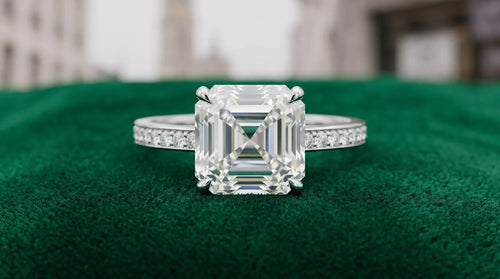
The most requested vintage reference in our bespoke studio today. Geometric precision, architectural confidence, cool contrast. Emerald cuts, Asscher cuts, baguette accents, black onyx, sharp symmetry. If you want to reset an antique stone into an Art Deco-inspired new setting, our step-cut guide explains why the Emerald and Asscher cuts are the architecturally correct choices.
Mid-Century Retro (1940s–50s)
Big, polished yellow gold volume. Cocktail rings with large semi-precious stones — Citrine, Aquamarine, Amethyst. Post-war optimism expressed through maximalism. Hollywood glamour translated into wearable, substantial jewellery. The antithesis of Edwardian delicacy.
07. The Modern Heirloom
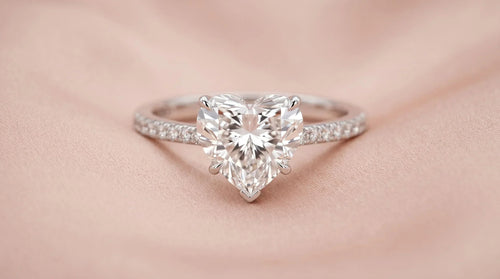
Perhaps you do not want to look vintage at all. Perhaps you want the "New York" aesthetic — an antique Old Mine Cut diamond set in a razor-thin, ultra-modern solitaire with eagle-claw prongs and a matte-finished shank. This Old Stone / New Setting juxtaposition is one of the most compelling outcomes in contemporary fine jewellery — and one of our most requested.

It says: "I respect the past, but I live in the present." The tension between the stone's age and the setting's modernity is precisely what makes it interesting. We recommend 18k Yellow Gold for antique diamonds in modern settings — the warmth of the metal complements the slightly lower colour grades (typically J, K, L) common in Victorian and Edwardian stones, and creates a cohesive, intentional warmth that white gold or platinum would work against. Browse our diamond ring collection for modern setting references before your consultation.
08. Case Study: The Divorce Ring
Not all heirlooms carry happy memories. We regularly see clients with what they call "Divorce Rings" — beautiful diamonds imprisoned in settings full of difficult associations.
The Project: A client brought in a classic three-stone engagement ring from a dissolved marriage. She wanted to keep the diamonds — they are innocent, after all — but change the energy entirely. The original setting had to go.
The Transformation: We removed the two side stones and set them as diamond stud earrings — symbolic of independence and self-possession. We took the centre stone and set it East-West (horizontally rotated) in a thick hammered yellow gold bezel as a pendant.

The Result: The ring was gone. The heavy energy was gone. She left with a Freedom Necklace and Power Studs. The stones that had witnessed a marriage now mark its transformation — same diamonds, entirely new meaning. This is the most profound expression of the Heirloom Renaissance.
09. Provenance: Documenting the Story
An heirloom is only as meaningful as its story. By resetting a piece, you risk losing the narrative that gives the stone its emotional weight — unless you document deliberately.
The Archive Package
Before we touch any piece, our team professionally photographs it in its original state under controlled lighting. We document every hallmark, every prong angle, every detail of the original design. We create a Before & After record — a visual archive that travels with the stone through the reset and beyond. This way, you can show your children: "This diamond came from Great-Grandmother's ring, and the ring looked like this." The lineage is preserved even as the metal changes. This documentation also supports the insurance and appraisal process for the finished piece.

10. Understanding Patina
Clients often ask why old gold looks softer and warmer than new gold. The answer is patina — the accumulation of thousands of microscopic wear marks over a century that collectively create a satin luminosity. It is the visual record of the piece being lived in. Patina cannot be perfectly faked; it can only be earned through time.
Warning: If you take an antique ring to a standard jeweller for cleaning, they will often buff it on a high-speed polishing wheel. This strips the patina completely in seconds and leaves the piece looking like cheap new gold — shiny, generic, and stripped of its history. Never over-polish an antique piece. When we clean antique jewellery at our atelier, we use gentle methods that remove dirt without removing the surface character. Our care guide covers these protocols in full.
11. Appraisal vs. Sentiment
| Type of Value | Definition | Reality Check |
|---|---|---|
| Insurance Replacement Value | The cost to replace the piece new, at retail. | Usually inflated relative to market value. The number used for your insurance policy. |
| Estate / Market Value | What you could realistically sell the piece for today. | Typically lower. The second-hand market is not kind to vintage settings — only to exceptional signed pieces or high-quality stones. |
| Sentimental Value | The memory carried in the object. | Priceless and uninsurable. No number on any appraisal document captures this. |
When you reset a piece, you require a new appraisal. The object has changed — its dimensions, its setting, its metal, and its market replacement cost are all different. We provide a full comprehensive appraisal for insurance purposes with every heirloom reset commission, specifying the stone quality, setting specification, and current replacement value at retail.
12. The Investment Case: Resetting vs. Buying New
From a purely financial perspective, resetting an inherited stone is the most efficient jewellery "purchase" you can make. You are bypassing the most expensive component — the diamond itself.
The Math of Resetting
Scenario A (Buy New): A new high-quality 2ct oval engagement ring at Zizov quality specification costs €25,000–€35,000.
Scenario B (Reset Heirloom): You have a 2ct Old Mine Cut diamond inherited from your grandmother. You commission a new bespoke setting (€3,000–€5,000 depending on design complexity) and receive metal credit for the old gold.
Result: You have a €30,000-equivalent ring for €4,000–€5,000. The stone already belongs to you — you are paying only for the craftsmanship of its new home. This is how thoughtful collectors build jewellery wardrobes of extraordinary quality without extraordinary spend.
For the broader picture of natural diamond value and appreciation, see our 2026 investment guide. A well-documented heirloom stone with provenance — particularly an Old Mine Cut from a known family period — carries additional narrative value beyond its GIA-graded specifications.
13. The Ethical Choice: Sustainable Luxury
The most sustainable diamond is the one that already exists. By repurposing an heirloom stone, you opt out of the mining cycle entirely. The carbon cost of the stone's extraction happened a century ago — resetting it has no new geological impact. This is one of the most genuinely ethical positions available in fine jewellery, and one that our sustainability commitment actively encourages. For the full context of diamond sourcing ethics, see our ethical diamond guide. Even the metal credit process is circular: your old gold enters the gold refining ecosystem to be purified and reused in other applications rather than going to waste.
14. Hallmarks: Decoding the Hidden Language
Inside most antique European jewellery, a series of tiny stamped marks tells the complete administrative story of the piece. These are hallmarks — the passport of the object. In Europe, particularly the UK, France, the Netherlands, and Belgium, hallmarking laws have been strict for centuries. A hallmark can tell you the maker (a specific house or workshop), the metal purity (750 for 18k gold, 950 for platinum), the date of manufacture (specific letter codes by jurisdiction), and the assay city (an anchor mark for Birmingham; a leopard's head for London).
What Happens to Hallmarks When We Reset?
For Restorations, we fight to preserve them. We will repair the shank around the stamps rather than replacing the section that carries them. The hallmarks are historical documents — their presence is part of the piece's value.
For Resets (making a completely new setting), the old hallmarks disappear with the old metal — which you receive credit for. The new ring is stamped with the Zizov Maker's Mark and the current year's Assay stamp. This is a poignant moment: you are officially closing the 1924 chapter and opening the 2026 chapter. Your name — or your fiancé's — becomes part of the stone's lineage for the next generation to discover inside the band of what will become their inheritance.
15. Care for Antique Jewellery
If you choose to preserve a piece in its original form, treat it with the same careful attention you would give an elderly relative. The standard protocols from our care guide apply — with additional cautions specific to antique pieces.
- No Ultrasonic Machines: Never place antique jewellery in ultrasonic cleaners. The vibration frequency can shake loose stones that are held only by worn prongs, and can crack stones with surface-reaching fractures. Warm water, mild soap, and a soft brush only.
- No Water for Foil-Backed Stones: Some Georgian jewellery (pre-1830s) features foil placed behind stones to amplify their brightness. If water penetrates the setting, the foil oxidises to black and the stone appears to die. Identify the era before cleaning.
- Clasp Attention: The mechanisms on antique brooches, chokers, and lockets were engineered for the standards of their century, not ours. Test before wearing. Add a safety chain to anything with collector or sentimental value.
- Annual Inspection: Bring antique pieces to our atelier annually for prong inspection, joint assessment, and professional cleaning. Prevention is incomparably less costly than recovery after loss.
16. Expert FAQ
What is a Toi et Moi ring, and how does it apply to heirlooms?
A Toi et Moi ("You and Me") ring features two stones — often different shapes or colours — sitting side by side on a single band. For heirlooms, it is the perfect solution when you have two smaller inherited stones (for example, two 0.80ct Old Mine Cuts from different grandmothers) that you want to combine into one meaningful piece. See our Toi et Moi guide for the full design language and possibilities. Book a consultation to discuss combining your specific stones.
Can you chip my diamond when removing it from the old setting?
It is extremely rare for a diamond to chip during careful unsetting — but not impossible if the stone has an existing hairline fracture that was concealed under a prong. We are fully insured, and more importantly, we perform a 3D scan and microscopic stress assessment of every stone before touching anything. If we determine that a stone carries unacceptable fracture risk during removal, we will tell you directly rather than proceed. Our Antwerp team always errs on the side of protecting the stone over proceeding with the project.
I have loose stones from 3 different family rings. Can I combine them?
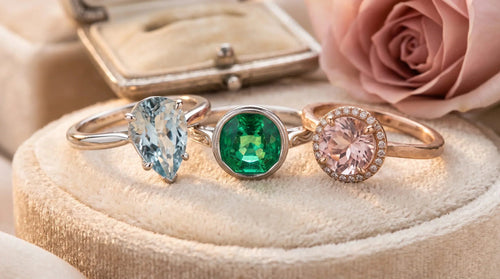
Yes — and these multi-family commissions are among our most meaningful projects. Bringing together a grandmother's diamond, a mother's sapphire, and your own piece into a single bespoke ring creates a jewellery heirloom that carries three generations of family history simultaneously. The design challenge is making three different stones work in visual harmony — which is precisely what our design process is built for. Book a consultation and bring everything.
How long does a bespoke heirloom reset take?
Typically 4–6 weeks from consultation to delivery. It is slightly longer than a standard new bespoke commission because the precision scanning, custom seat-carving, and additional care required for non-standard antique stones adds time to the setting phase. If you have a specific date in mind — an anniversary, a proposal, a milestone — tell us at the outset and we will plan accordingly. Contact our team to discuss timelines.
My diamond has a chip. Can you fix it?
Yes. We can re-polish the diamond to remove the chip. Polishing requires removing material — typically 0.05ct to 0.10ct depending on the chip's depth and location on the stone. We calculate the precise weight loss before you commit to the process, so you know exactly what the post-polish stone will weigh and how that affects the setting dimensions. For antique stones where the original weight has sentimental meaning, we present the trade-off clearly and let you decide. Book a consultation to bring the stone for assessment.
Ready to Reset?
Book a consultation with our Bespoke Team at our Antwerp atelier. Bring your jewellery box. Let's see what treasure is hiding inside. For reference, browse our ring collection, pendant collection, and earring collection for setting reference before your visit.
 Book Heirloom Consultation
Zizov Diamonds Antwerp
Preserving History. Creating Future.