Diamond Carat Size Guide: What Does 1 Carat Actually Look Like?

Of all the questions asked about diamonds, none is more universal or more misunderstood than "how big is 1 carat?" The word "carat" sounds substantial — and the price certainly feels substantial — but the actual physical reality is often surprising to first-time buyers. A 1-carat round brilliant diamond is approximately 6.4mm in diameter. Roughly the size of a pencil eraser. Less than a quarter of an inch. And yet, set in a solitaire ring, a 1-carat stone can be breathtaking. The gap between what a number means and what it looks like on a hand is the central challenge of buying a diamond — and this guide closes it completely. Browse our engagement ring collection and our diamond collection with fresh context after reading.
01. Carat Is Weight, Not Size
This is the single most important thing to understand before any diamond purchase. Carat measures weight, not dimensions. One carat equals exactly 0.20 grams — approximately the weight of a small paper clip. The metric tonne has 1,000,000 grams; a 1-carat diamond has 0.20 of one of them.
Why does this matter practically? Because two diamonds of the exact same carat weight can appear completely different sizes depending on how their weight is distributed. A diamond cut too deep "hides" carat weight in pavilion depth below the setting, where it is invisible from above. A well-cut diamond distributes its weight efficiently across the face-up surface, where it is entirely visible. The result: a 0.90ct diamond with excellent cut proportions can appear larger than a 1.10ct diamond with poor proportions. This is not a theoretical edge case — we see it regularly at the Antwerp showroom, and it is one of the most important reasons why cut quality is the #1 priority in our engagement ring guide.
02. The Millimetre Guide — Round Diamonds
For round brilliant diamonds, the relationship between carat weight and diameter is reasonably predictable for well-cut stones. Here are the approximate face-up dimensions for excellent-cut rounds:
These are approximate values for well-cut round brilliants. Individual stones vary by ±0.2mm depending on exact proportions. Always request the specific millimetre measurements from the GIA certificate (listed under "Measurements") rather than relying on carat weight alone to predict size.
"The question is never 'how many carats?' — it's always 'how many millimetres face-up?' Carats are the cost; millimetres are the beauty."
03. How Shape Changes Apparent Size
Different diamond shapes distribute their weight differently across the face-up surface, creating dramatically different apparent sizes for the same carat weight. This is one of the most powerful tools a buyer has — choosing a shape that "faces up large" can deliver the visual impact of a stone 20–30% heavier for the same budget.
| Shape | 1.00ct Dimensions | Apparent Size vs Round | Collection |
|---|---|---|---|
| Round Brilliant | ≈ 6.4 × 6.4mm | Baseline | Round solitaires |
| Oval Cut | ≈ 7.7 × 5.7mm | +10–15% larger face-up | Oval collection |
| Marquise | ≈ 10.0 × 5.1mm | +15–20% larger face-up | Shape guide |
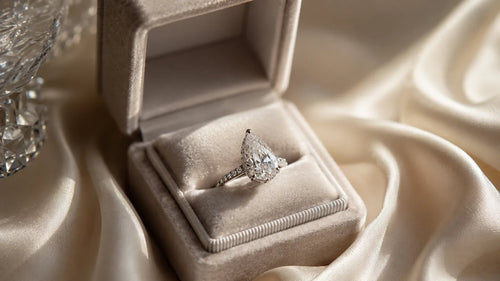
| Pear | ≈ 8.5 × 5.7mm | +10–15% larger face-up | Shape guide |
| Cushion Cut | ≈ 5.9 × 5.9mm | Approximately equal | Cushion collection |
| Princess Cut | ≈ 5.5 × 5.5mm | Slightly smaller face-up | Princess collection |
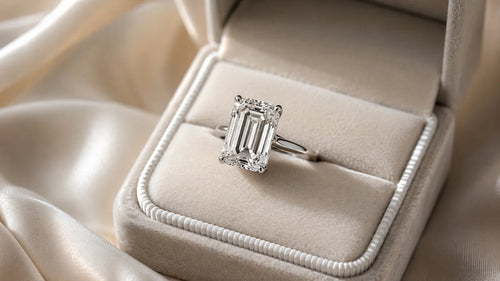
| Emerald Cut | ≈ 6.5 × 5.0mm | Approximately equal (narrow) | Emerald collection |
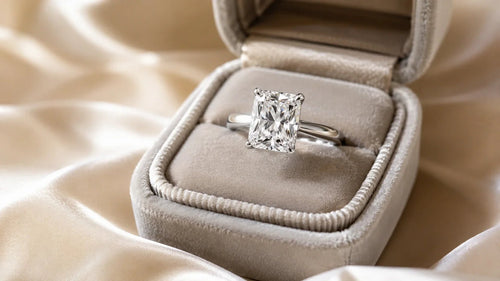
| Radiant Cut | ≈ 5.8 × 5.8mm | Approximately equal | Radiant collection |
| Asscher Cut | ≈ 5.5 × 5.5mm | Smaller face-up (weight in depth) | Asscher collection |
The practical conclusion: if maximising apparent size within a fixed budget is the priority, elongated shapes (Oval, Marquise, Pear) deliver the best face-up size per carat. Step-cut shapes (Asscher, Emerald) have their weight concentrated in depth, producing a smaller face-up footprint — but compensating with the compelling Hall of Mirrors depth effect. See our complete shape guide and our dedicated Emerald vs. Asscher guide.

04. Size on the Hand — Finger Width Matters
The "right" carat size is not an absolute number — it is a number relative to the specific hand wearing the ring. A 1.00ct round brilliant looks exceptional on a size 5 (EU 49) finger but may appear modest on a size 8 (EU 58) finger. The stone's visual impact on the hand is determined by the ratio of stone diameter to finger width, not by the carat number on the certificate.
| Finger Size | Finger Width (approx.) | Min. Recommended | Ideal Range |
|---|---|---|---|
| EU 46–50 (XS–S) | 14–15mm | 0.50ct round (5.1mm) | 0.70–1.50ct for visual balance |
| EU 51–55 (S–M) | 15–16mm | 0.70ct round (5.7mm) | 1.00–2.00ct for visual balance |
| EU 56–60 (M–L) | 17–18mm | 0.90ct round (6.2mm) | 1.20–2.50ct for visual balance |
| EU 61+ (L–XL) | 19mm+ | 1.00ct+ for visible presence | 1.50ct+ recommended |
These are guidelines, not rules. Personal preference, setting style, and lifestyle all modify the ideal size. The only way to truly know what looks right on a specific hand is to try stones on — which is precisely the purpose of a consultation at our Antwerp showroom. We regularly place 0.70ct and 1.50ct stones on the same hand for comparison. The gap between the two looks completely different from what the numbers suggest.
05. Magic Sizes & Price Jumps
Diamond prices on the Rapaport pricing matrix jump significantly at specific carat thresholds — what the trade calls "magic sizes." These jumps reflect demand: buyers universally search for "1ct diamond" rather than "0.97ct diamond," creating artificial price pressure at the round numbers.
The Magic Size Strategy
The price-per-carat jump between 0.99ct and 1.00ct can be 15–25% for identical quality grades. But the visual difference between the two stones is, in practice, invisible — approximately 0.1mm in diameter. The strategic approach: buy a stone in the 0.90–0.99ct range (or 1.45–1.49ct, 1.90–1.99ct) and use the saving to upgrade Cut quality, Colour grade, or the setting itself. You receive the same visual result for measurably less money. This is one of the most reliably useful insights in the engagement ring buying guide.
Conversely: if you are buying for investment purposes, buy strictly above the magic sizes (1.01ct, 1.51ct, 2.05ct) — secondary market demand concentrates at full-carat thresholds, maximising resale value.
06. Why Cut Determines Visual Size More Than Carat
A poorly proportioned diamond hides its carat weight in depth. The "nailhead" and "fisheye" effects described in our buying guide are both examples of weight that pays a carat premium but contributes nothing to visible size. A 1.20ct stone with Poor cut proportions may show a 6.0mm face-up diameter — less than a well-cut 1.00ct at 6.4mm.
The practical implication: buy the highest Cut grade first, then maximise carat weight within that constraint. A 0.90ct Excellent-Cut round brilliant will look more impressive — and be more brilliant — than a 1.15ct Very Good-Cut round brilliant at the same price point. Cut efficiency is the single most powerful tool for maximising visible size within a budget. For round brilliants, specify GIA Excellent Cut only. For fancy shapes like the oval, cushion, and radiant, Cut grade is not independently assessed by GIA — which makes in-person inspection or video review non-negotiable.
07. The Budget vs. Carat Trade-off
The three-way relationship between budget, quality, and carat weight determines every engagement ring purchase. You can optimise for any two of the three — but not all three simultaneously. Understanding the trade-offs clearly allows you to make the choice that matches your priorities:
- Priority: Maximum carat weight — choose a larger stone in a lower colour grade (H–J) and lower clarity (SI1 eye-clean). The sparkle and size will be impressive; the technical grades will be modest on paper. Best for yellow gold settings where lower colour grades face up beautifully.
- Priority: Maximum quality in the stone — choose D–F colour, FL–VVS clarity, and accept a smaller carat weight. A 0.70ct D/IF stone is a genuine collector-grade asset. Best for buyers with investment considerations or who plan long-term ownership.
- Priority: Balance — the sweet spot most buyers find: G–H colour, VS1–VS2 clarity, Excellent cut, 0.90–1.20ct. This delivers a stone that is genuinely beautiful, faces up white, is eye-clean, and is priced fairly. Our Antwerp sourcing team specialises in finding the stones within this range that represent exceptional value relative to their certificate position.
08. Complete Size Reference Chart by Shape
| Carat | Round (dia.) | Oval (L×W) | Cushion (dia.) | Emerald (L×W) |
|---|---|---|---|---|
| 0.50ct | 5.1mm | 6.5 × 4.8mm | 4.9mm | 5.5 × 4.1mm |
| 0.75ct | 5.9mm | 7.0 × 5.2mm | 5.4mm | 6.0 × 4.5mm |
| 1.00ct | 6.4mm | 7.7 × 5.7mm | 5.9mm | 6.5 × 5.0mm |
| 1.25ct | 6.9mm | 8.3 × 6.1mm | 6.3mm | 7.0 × 5.3mm |
| 1.50ct | 7.4mm | 8.8 × 6.5mm | 6.7mm | 7.4 × 5.6mm |
| 2.00ct | 8.1mm | 9.7 × 7.2mm | 7.2mm | 8.1 × 6.2mm |
| 3.00ct | 9.3mm | 11.0 × 8.2mm | 8.3mm | 9.3 × 7.2mm |
All measurements are approximate for well-proportioned stones. Individual variations occur. For precise measurements, refer to the "Measurements" line on the GIA Grading Report for each specific stone.

09. Expert FAQ
How big is a 1 carat diamond?
A well-cut 1-carat round brilliant diamond is approximately 6.4mm in diameter — roughly the size of a pencil eraser. However, the visual size on the hand varies significantly by shape: a 1-carat oval appears 10–15% larger due to its elongated footprint, while a 1-carat Asscher cut appears slightly smaller due to weight concentrated in depth. Always check the millimetre measurements on the GIA certificate alongside the carat weight. See our shape guide for a full comparison.
What is the difference between carat and size?
Carat measures weight (1 carat = 0.20 grams). Size refers to the physical dimensions — diameter for round stones, length and width for fancy shapes. Two diamonds of identical carat weight can appear very different sizes depending on shape and cut proportions. A poorly cut 1.20ct stone may appear smaller than a well-cut 1.00ct stone of the same shape, because the extra weight is buried in depth. This is why we prioritise Cut quality in every recommendation at Zizov.
What is a magic carat size?
Magic sizes are the carat thresholds where diamond prices jump significantly: 0.50ct, 1.00ct, 1.50ct, 2.00ct, 3.00ct, and 5.00ct. Buying just below these thresholds (0.49ct, 0.97ct, 1.48ct) delivers the same visual result at meaningfully lower cost — typically 15–25% savings. Conversely, for investment stones, buy strictly above the magic sizes to ensure maximum resale demand. See our complete buying guide for the full strategy.
How many carats should an engagement ring diamond be?
The average engagement ring diamond in Europe is approximately 0.80 to 1.20 carats. However, the right size is entirely personal and depends on budget, her finger width, her lifestyle, and the chosen shape. A 0.70ct oval can look larger and more impressive than a 1.00ct Asscher cut on the same hand. Book a consultation at our Antwerp showroom to try different weights on your specific hand — it is the only reliable way to find the right size.
Does a bigger carat mean a bigger diamond?
Not necessarily. A poorly cut 1.50ct diamond may show the same face-up diameter as a well-cut 1.20ct diamond, because the additional weight is buried in excessive pavilion depth rather than distributed across the face-up surface. This is the most important practical implication of understanding that carat measures weight, not size. Always evaluate millimetre dimensions from the GIA certificate alongside carat weight, and prioritise GIA Excellent Cut for round brilliants to ensure efficient weight distribution.
See the Sizes in Person
Numbers on a page are a starting point. The only way to truly understand what a carat weight looks like on your hand is to try it. Book a private viewing at our Antwerp showroom and we will arrange a curated selection of stones at different weights, shapes, and qualities so you can compare directly. Browse our engagement ring collection, oval collection, and full diamond ring range before your visit. Need something in the next few days? See our express delivery collection.
Book Size Comparison ViewingZizov Diamonds Antwerp
Excellence in every facet.